anti-theodicy
Explanation
The Joke
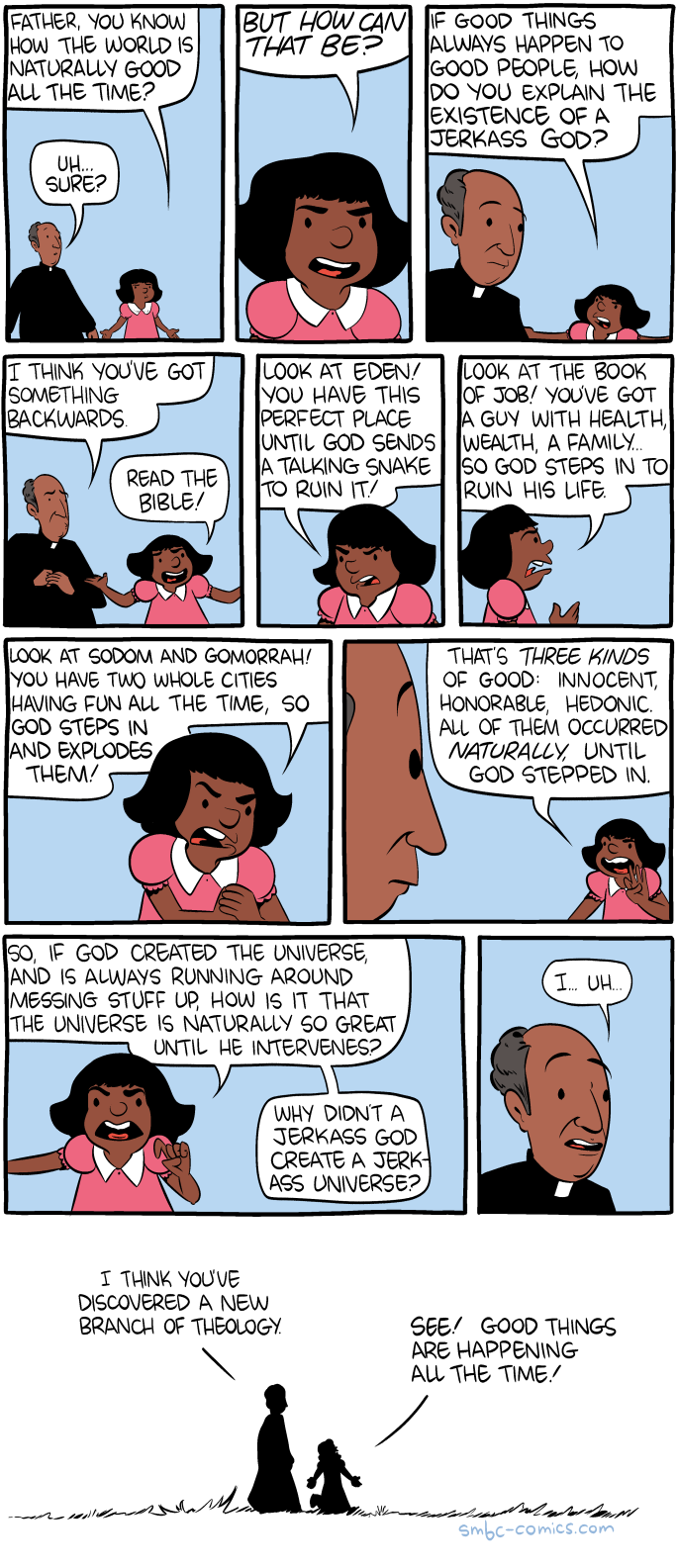
A woman poses a philosophical challenge to a man: "Do you know how the world is naturally good all the time?" When he agrees, she flips the classic Problem of Evil on its head. Instead of asking why a good God allows bad things to happen, she asks: if good things always happen to good people, how do you explain the existence of a seemingly evil God? This is the "anti-theodicy" referenced in the title -- a mirror image of the traditional theological problem.
The man tries various responses that parallel classic theodicy arguments but in reverse. He suggests that God has a "perfect plan" (echoing the "divine plan" defense), that there is a book explaining it all (paralleling religious texts), and that God is "training humans to be good" (echoing the soul-making theodicy). The woman counters each one, noting contradictions: why would a supposedly evil God create a world with health, beauty, and goodness? Why do good steps lead to further good? The man grows increasingly flustered.
In the final panels, the man tries arguing that God created the universe and is always running around causing trouble, but the universe is naturally so great that it all works out anyway. The woman observes that he has essentially discovered a new branch of theology. The bonus panel shows the man pointing out "See? Good things are happening all the time!" -- completing the comedic inversion by showing him now arguing the exact opposite of what a traditional theodicist would argue.
The Humor
The comic is a brilliant structural inversion of theodicy -- the branch of theology that tries to reconcile the existence of evil with an all-good, all-powerful God. Here, the problem is reversed: how do you reconcile the existence of good with an apparently evil (or at least jerky) God? The humor comes from how perfectly the standard theodicy arguments map onto this inverted scenario, revealing how formulaic and interchangeable those arguments can be. Every classic defense ("God works in mysterious ways," "it is all part of a plan," "suffering builds character") has an exact mirror, and they sound equally plausible -- or equally absurd -- in either direction.
The comic also pokes fun at how theological argumentation can sometimes become so abstract and self-referential that the same logical structure can be used to argue for completely contradictory positions.
References
Theodicy is a term coined by philosopher Gottfried Wilhelm Leibniz in 1710, referring to attempts to justify the existence of God in the face of evil. The "Problem of Evil" is one of the oldest philosophical challenges to theism, famously articulated by Epicurus and later by David Hume. Common theodicies include the Free Will Defense (Alvin Plantinga), the Soul-Making Theodicy (John Hick), and the "best of all possible worlds" argument (Leibniz). The comic inverts all of these into an "anti-theodicy" -- a term that in real philosophy refers to arguments that the existence of evil is incompatible with God, but here is playfully reimagined as the problem of explaining good in a universe with a bad God.