anything

Explanation
The Joke
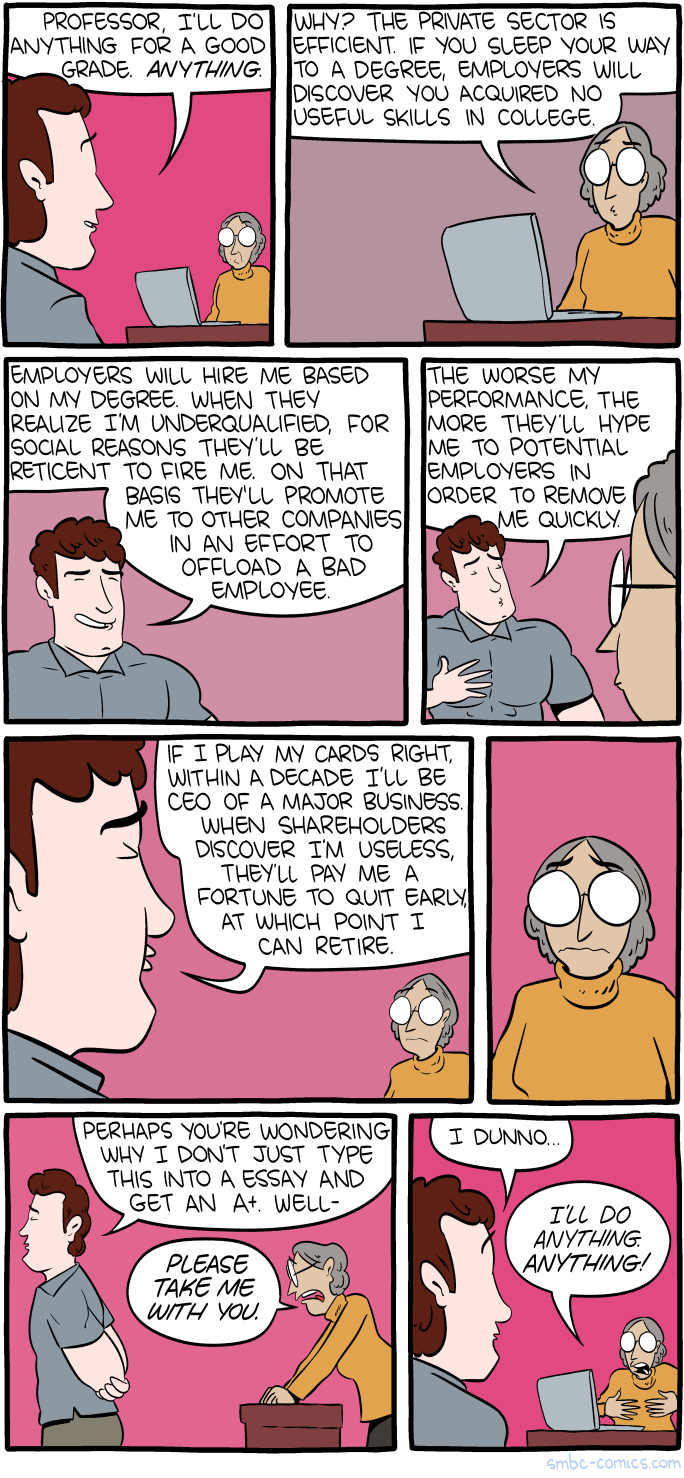
A student tells a professor "I'll do anything for a good grade. Anything." The professor, rather than being tempted by the suggestive offer, launches into a brutally honest explanation of how the private sector works: if you sleep your way to a degree, employers will discover you have no useful skills; they'll hire you based on your degree, then when they realize you're unqualified, they'll be too reticent to fire you and will instead promote you to other companies to offload a bad employee; the worse your performance, the more you'll be hyped to potential employers to get rid of you faster; and if you play your cards right, within a decade you'll be CEO of a major business, at which point shareholders will discover you're useless and pay you a fortune to quit early so you can retire.
The student asks why the professor doesn't just type this into an essay for an A+, and pleads "Please take me with you." The professor pauses, says "I dunno," and the student exclaims "I'll do anything! Anything!" -- completing a loop where the same desperate plea now has an entirely different (and funnier) meaning.
The Humor
The comedy works on multiple levels. First, it subverts the "I'll do anything" trope by having the professor respond with a cynical but disturbingly accurate description of corporate dysfunction rather than anything inappropriate. The extended monologue about failing upward is funny because it describes a real phenomenon -- the Peter Principle and corporate mediocrity -- through the lens of deliberate strategic incompetence. The circular structure of the joke, where "I'll do anything" transforms from a suggestive proposition into a genuine plea for career advice, is the final clever touch. The professor has inadvertently described a career path so appealing that the student now wants mentorship rather than a grade.
References
- The Peter Principle: The management theory (formulated by Laurence J. Peter in 1969) that employees in a hierarchy tend to be promoted to their level of incompetence.
- Failing upward: The well-documented corporate phenomenon where poor performers are promoted or transferred rather than fired, often to avoid the difficulty of termination.