apple-3
Explanation
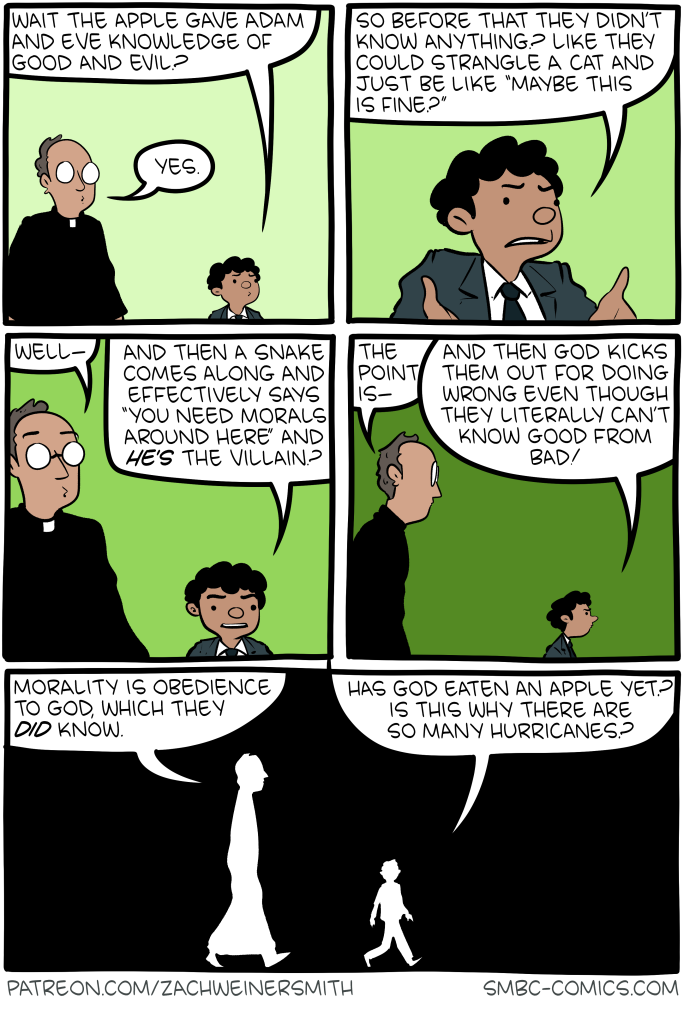
This comic retells the story of the Garden of Eden from the Book of Genesis, with a cynical twist. A narrator (apparently God or an angel) recounts the biblical story: "Isn't the apple game about how God gave us knowledge of good and evil?"
The retelling continues: "So before that, they didn't know anything was wrong? Like getting punished by a stranger and a cat and stuff? It must be like, 'What's the big deal?'" This references the fact that before eating from the Tree of Knowledge of Good and Evil, Adam and Eve had no concept of right and wrong.
Then: "And then a giant comes along and says 'you need morals now!' And after they get morals... they're villains?" This points out the logical oddity in the Genesis story: God punishes Adam and Eve for disobeying a command they received before they had the moral knowledge to understand concepts like obedience, disobedience, right, or wrong.
The punchline at the bottom reads: "Morality is obedience to rules whose origins go back before there was any moral understanding." A character adds: "I love language!"
The comic highlights a well-known philosophical and theological paradox in the Eden narrative. If Adam and Eve did not yet possess knowledge of good and evil, how could they be held morally responsible for the "sin" of eating the forbidden fruit? They couldn't have known that disobedience was wrong because the very concept of "wrong" was contained in the fruit they hadn't yet eaten. This is a version of the problem that theologians and philosophers have debated for centuries. The comic also makes a broader point about the nature of morality -- suggesting that moral codes often originate from arbitrary authority rather than from reasoned understanding, and that we follow rules whose origins predate our ability to evaluate them critically. The "I love language" quip at the end seems to sarcastically appreciate how religious language obscures this logical problem.