arbitrarily
Explanation
The Joke
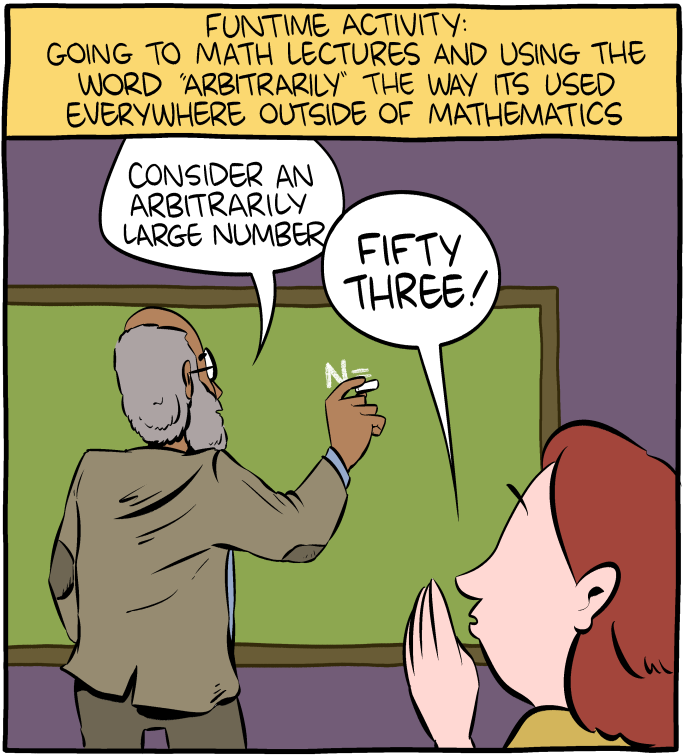
The comic is titled "Funtime Activity: Going to math lectures and using the word 'arbitrarily' the way it is used everywhere outside of mathematics." A math professor at a chalkboard says "Consider an arbitrarily large number," and a student enthusiastically shouts "Fifty-three!"
In mathematics, "arbitrarily large" means "as large as you need it to be" -- it is a formal way of saying that a statement holds for any number, no matter how large. It does not mean "a random number" or "a number chosen on a whim." However, in everyday English, "arbitrarily" means "randomly" or "without any particular reason or method." So the student, using the common English meaning, just picks a random number -- fifty-three -- which is not even particularly large, making the misunderstanding even funnier.
The Humor
The joke captures a genuine tension between mathematical and colloquial language. Mathematicians use many common English words (like "arbitrary," "trivial," "normal," "regular") with precise technical meanings that differ significantly from their everyday usage. The student's response of "fifty-three" is perfect because it is both genuinely arbitrary (in the common sense) and decidedly not large in any mathematical context, doubly violating the intent of the professor's statement. The framing as a "Funtime Activity" adds to the humor by suggesting this is a prank one might actually perform at a real lecture, turning a pedantic linguistic observation into an act of gleeful disruption.
References
The comic references the mathematical concept of "arbitrarily large," which is used in analysis, number theory, and other fields to express that a property holds without upper bound. For example, one might say "there are arbitrarily large prime numbers," meaning that for any number N, there exists a prime number larger than N. This is distinct from saying "there is a randomly chosen large prime."