art
Explanation
The Joke
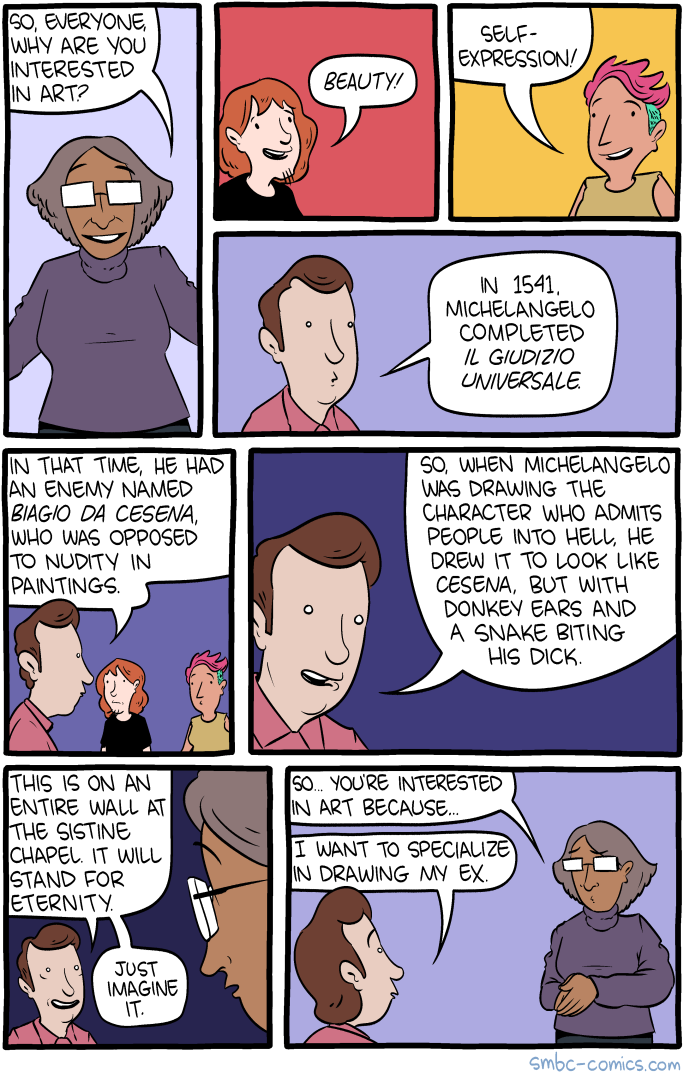
The comic opens with people being asked why they are interested in art. They give the typical, noble-sounding answers: "Beauty!" and "Self-expression!" Then the comic cuts to a history lesson about Michelangelo's work at the Sistine Chapel, noting that in 1541, Michelangelo added a character named Biagio da Cesena -- who was a real papal official who had criticized Michelangelo's work -- depicting him in Hell with donkey ears and a snake biting his genitals. This was Michelangelo's petty, personal revenge painted directly onto one of the most sacred works of art in history.
The final panel returns to the original question, where someone now gives the real answer: "I'm interested in art not because I want to appreciate beauty, but because I want to specialize in drawing my enemies in Hell." The joke is that art, for all its lofty ideals, has always partly been a vehicle for personal grudges and spite.
The Humor
The comedy relies on the contrast between the high-minded reasons people claim to appreciate art (beauty, self-expression) and the much pettier, more human motivation revealed by Michelangelo's actual behavior. The fact that one of history's greatest artistic masterpieces literally contains a spite portrait of the artist's critic is inherently funny, and the comic uses it to undercut every pretentious statement ever made about the purpose of art.
References
The historical anecdote is real. Biagio da Cesena, the papal Master of Ceremonies, criticized the nudity in Michelangelo's "The Last Judgment" on the Sistine Chapel ceiling. In response, Michelangelo painted Biagio into the fresco as Minos, judge of the underworld, with donkey ears and a serpent coiled around his body biting his genitals. When Biagio complained to Pope Paul III, the Pope reportedly replied that his jurisdiction did not extend to Hell.