art-4

Explanation
The Joke
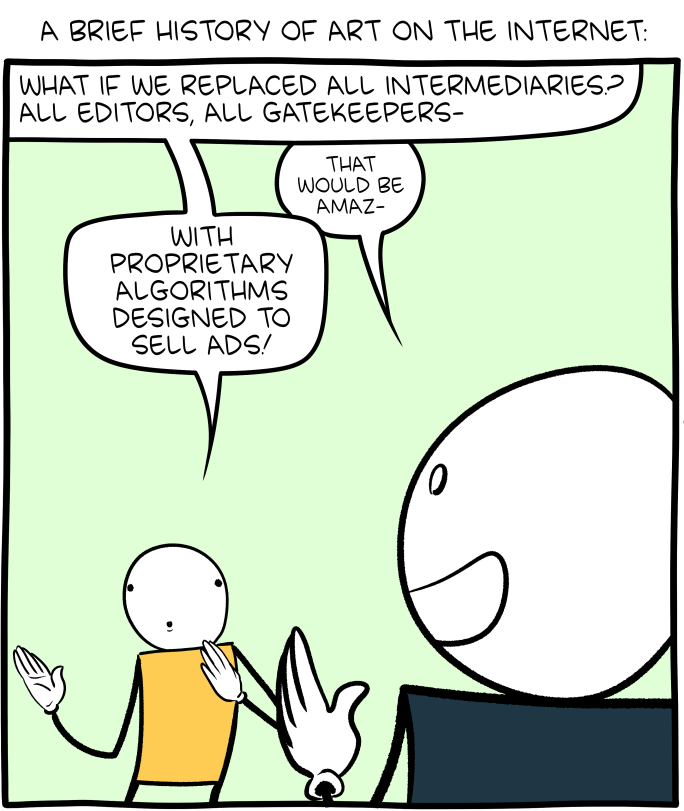
The comic is titled "A Brief History of Art on the Internet." A figure enthusiastically proposes: "What if we replaced all intermediaries? All editors, all gatekeepers—" Another figure begins to respond excitedly, "That would be amaz—" before the first figure finishes: "—with proprietary algorithms designed to sell ads!"
The Humor
The comic captures the bait-and-switch of how the internet disrupted creative industries. The initial promise of the internet was profoundly democratic: remove the traditional gatekeepers (publishers, gallery owners, record labels, studio executives) and let artists connect directly with audiences. This was genuinely exciting and revolutionary.
But the punchline reveals what actually happened: the old gatekeepers were not eliminated but replaced by something arguably worse — opaque algorithmic systems (YouTube's recommendation engine, Instagram's feed algorithm, Spotify's playlist curation, etc.) whose primary purpose is not to surface the best art but to maximize advertising revenue and engagement metrics.
The second figure's interrupted enthusiasm ("That would be amaz—") perfectly captures the historical moment when this pivot happened. The optimism of the early internet gave way to the realization that the new intermediaries are less accountable, less transparent, and less interested in artistic quality than the old ones. At least a human editor had aesthetic judgment; an algorithm optimizes for clicks.
This is a concise summary of a critique made by many internet scholars and artists: decentralization didn't eliminate power structures, it just replaced visible ones with invisible ones.
Votey
The red-button panel typically adds an additional punchline that extends or undercuts the comic's premise.