Autological
Explanation
The Joke
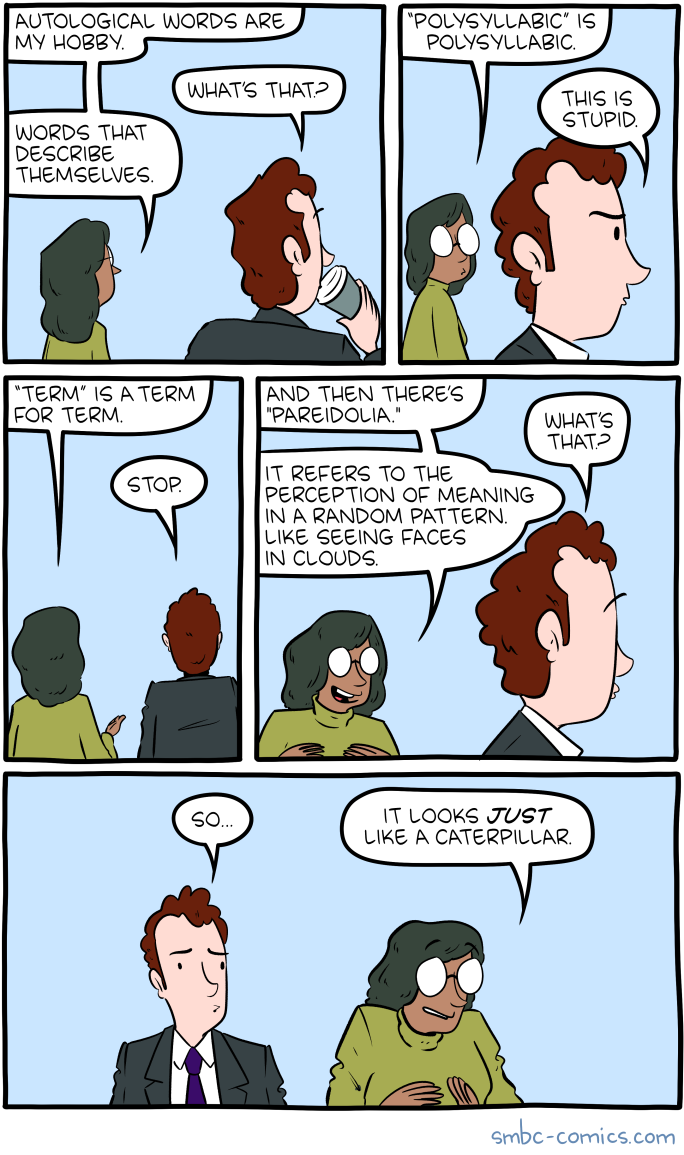
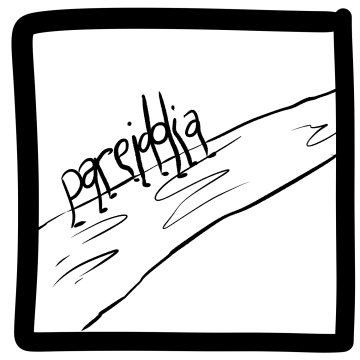
A character explains that "autological" words are words that describe themselves (for example, "short" is a short word, "English" is an English word). Another character dismisses this as stupid. The first character then introduces additional self-referential linguistic terms: "there is a term for a term that describes itself" and "pareidolia," which refers to the perception of meaningful patterns in random stimuli — like seeing faces in clouds. In the final panel, a character wearing what appears to be a frog or creature mask says "it looks just like a caterpillar," demonstrating pareidolia in real time by seeing a pattern (a caterpillar) in something that isn't one.
The comic stacks multiple layers of self-reference. The discussion of autological words is itself an example of language describing language, and the introduction of "pareidolia" is immediately followed by an instance of pareidolia — making the explanation itself autological in a meta sense.
The Humor
The comedy builds through escalating self-reference until the final panel delivers the punchline through visual demonstration rather than dialogue. The character seeing a "caterpillar" in the frog/creature mask is a perfect example of pareidolia happening in the moment, which ties the whole strip together. The dismissive "this is stupid" reaction from the skeptical character also serves as a knowing wink — Weinersmith acknowledges that this kind of linguistic navel-gazing can feel pointless, but then rewards the reader who stuck around with a cleverly layered payoff.
References
Autological words (also called "homological" words) are a real concept in linguistics and philosophy. The related paradox — whether "heterological" (a word that does not describe itself) is itself heterological — is known as the Grelling-Nelson paradox, a well-known problem in mathematical logic.