babbage-2

Explanation
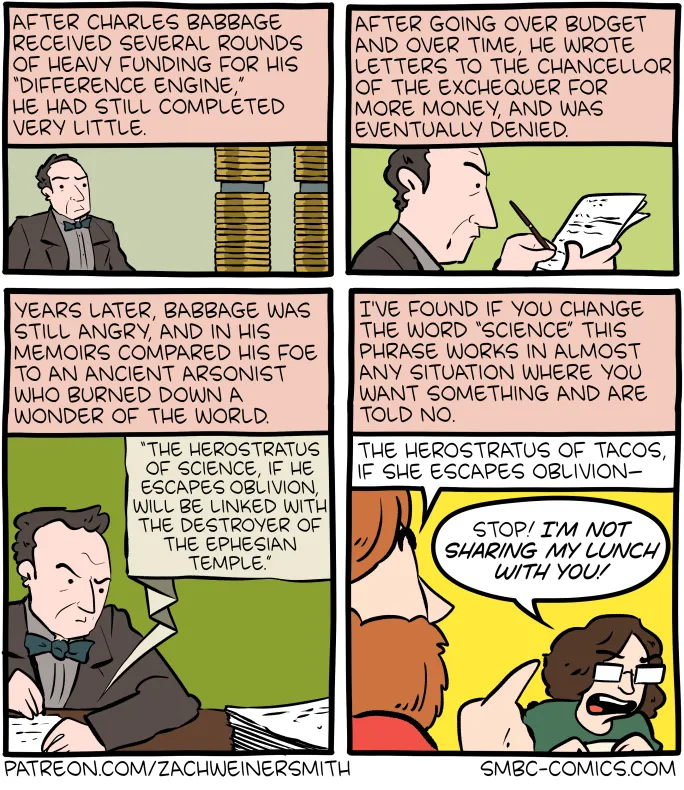
This comic tells a real historical anecdote about Charles Babbage, the 19th-century mathematician and inventor often called "the father of the computer," and then applies its lesson to everyday life.
The first two panels set up the historical context: Babbage received significant government funding for his "Difference Engine" (an early mechanical calculator), but went over budget and over time while completing very little. When he wrote to the Chancellor of the Exchequer requesting more money, he was eventually denied.
The third panel reveals Babbage's petty response: years later, still angry about the rejection, he wrote in his memoirs comparing the Chancellor to Herostratus, the ancient Greek who burned down the Temple of Artemis at Ephesus (one of the Seven Wonders of the Ancient World) solely to achieve lasting fame. The quote reads: "The Herostratus of Science, if he escapes oblivion, will be linked with the destroyer of the Ephesian temple." In other words, Babbage was saying that the Chancellor would only be remembered for the crime of destroying scientific progress, just as Herostratus is only remembered for his act of destruction.
This is historically accurate. Babbage really did make this comparison in his autobiography, "Passages from the Life of a Philosopher" (1864), and was notoriously bitter about the government's withdrawal of funding.
The punchline comes in the final panel, where a modern-day person has realized that you can substitute any noun for "science" in Babbage's formula and it works perfectly whenever you want something and are told no. They demonstrate by saying "The Herostratus of tacos, if she escapes oblivion--" only to be cut off by someone shouting "Stop! I'm not sharing my lunch with you!"
The humor lies in the contrast between Babbage's grandiose classical rhetoric -- comparing a budget dispute to the destruction of a Wonder of the World -- and the mundane pettiness of someone deploying the exact same rhetorical strategy to guilt a coworker into sharing lunch. The comic suggests that Babbage's famous insult was, at its core, the same kind of overwrought manipulation people use in everyday squabbles, just dressed up in 19th-century literary finery.