babbage
Explanation
The Joke
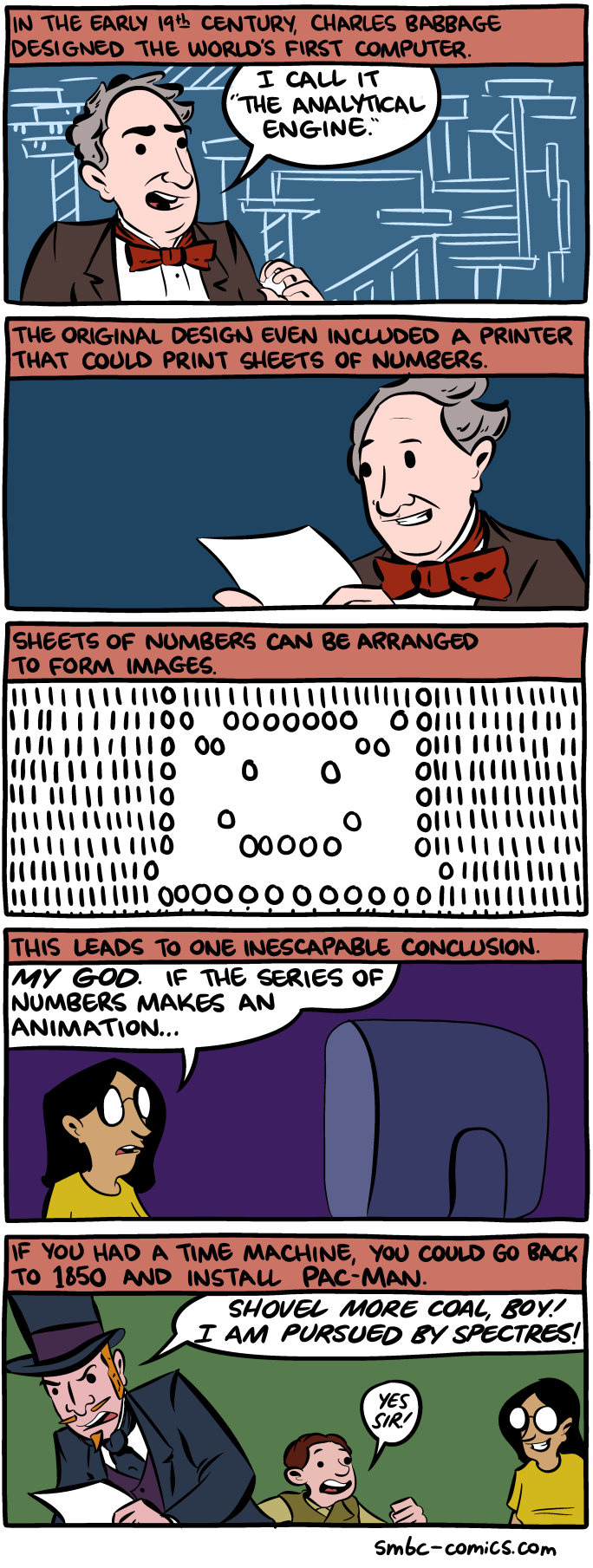
The comic presents a fictional history of Charles Babbage, who in the early 19th century designed the world's first computer, the Analytical Engine. The comic notes that the original design included a printer that could print sheets of numbers. It then observes that sheets of numbers can be arranged to form images (showing a grid of digits forming a simple picture, reminiscent of ASCII art). This leads to the "inescapable conclusion" that any series of numbers making an animation would constitute the first computer-generated animation. The final panel imagines what would happen if you had a time machine and went back to 1850 to show Babbage: he is frantically shoveling coal and screaming "Shovel more coal, boy! I am pursued by spectres!" -- implying you showed him an animation of ghosts and he mistook it for real supernatural entities.
The Humor
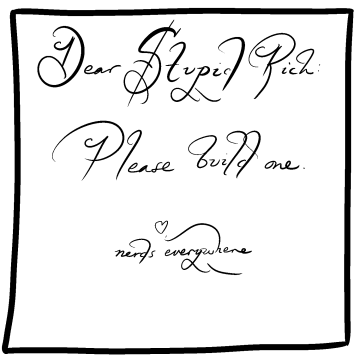
The comic constructs a deliberately absurd chain of logic: since Babbage's engine could print numbers, and numbers can form pictures, then it theoretically could have produced the first animation. This is technically true in a "spherical cow" kind of way, but wildly anachronistic. The real punchline is the time-travel scenario where showing Babbage a computer animation backfires spectacularly -- a man from the 1850s would have no frame of reference for animated images and would interpret them as actual ghosts or sorcery. The image of the dignified father of computing frantically shoveling coal to flee from what is presumably a simple GIF is a wonderful clash of eras.
References
- Charles Babbage (1791-1871) was an English mathematician and inventor who designed the Analytical Engine, widely regarded as the conceptual predecessor to modern computers. It was never fully built during his lifetime.
- The Analytical Engine did include a printer mechanism in its design, intended to print numerical tables. Babbage's collaborator Ada Lovelace is often credited as the first computer programmer for her work on the engine.
- ASCII art is a graphic design technique that uses printable characters from the ASCII standard to create images, which is what the comic alludes to when showing numbers arranged to form pictures.