bacon-is-literally-cancer
Explanation
The Joke
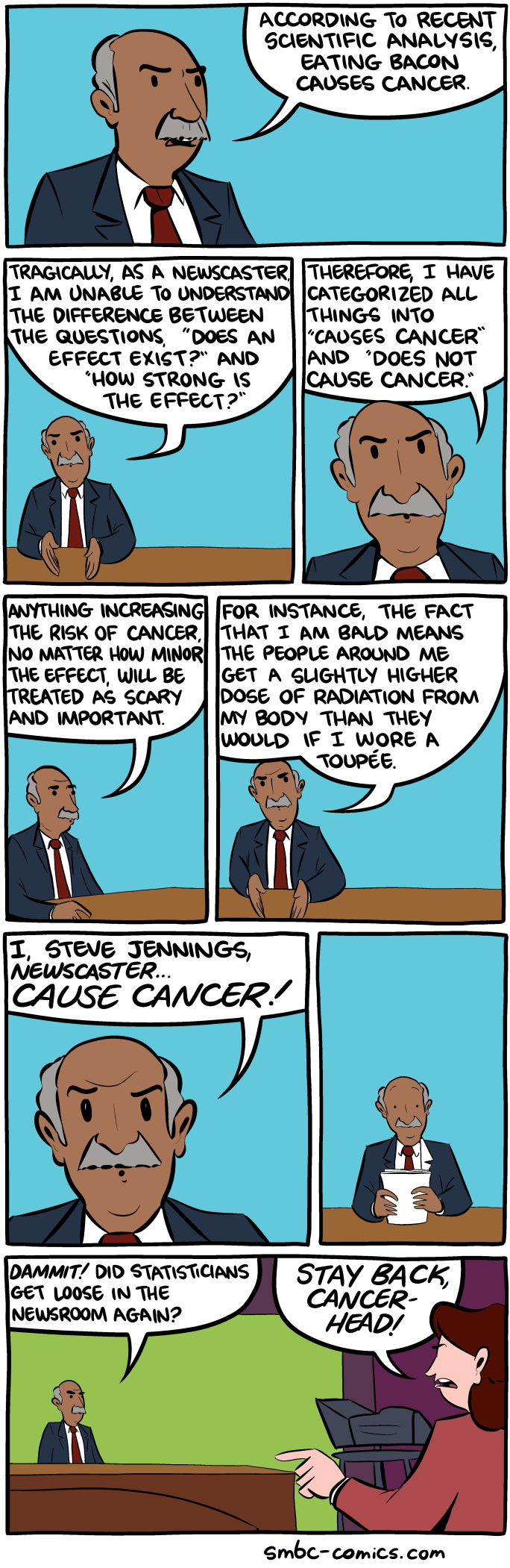
A newscaster reports that "according to recent scientific analysis, eating bacon causes cancer." He then admits that, tragically, as a newscaster he is unable to understand the difference between "Does an effect exist?" and "How strong is the effect?" He therefore categorizes everything into either "causes cancer" or "does not cause cancer." He goes on to demonstrate this flawed reasoning by noting that since anything increasing the risk of cancer — no matter how minor — will be treated as scary and important, he himself causes cancer, because his bald head emits slightly more radiation than it would if he wore a hat. He then melodramatically declares: "I, Steve Jennings, newscaster... CAUSE CANCER!" The final panel shows someone asking, "Did statisticians get loose in the newsroom again?" while another person yells, "Stay back, cancer-head!"
The Humor
This comic was published shortly after the World Health Organization's International Agency for Research on Cancer (IARC) classified processed meat (including bacon) as a Group 1 carcinogen in October 2015. The media coverage of this announcement was widely criticized for being sensationalized, with headlines implying that eating bacon was comparably dangerous to smoking, when in reality the classification refers to the certainty of the evidence, not the magnitude of the risk. The comic skewers this failure of science journalism by having the newscaster openly admit his inability to distinguish between the existence of an effect and its magnitude, then taking this logic to its absurd conclusion — that everything, including his own head, "causes cancer." The final panel, where a statistician has apparently infiltrated the newsroom to correct the reporting, adds a layer of humor about the tension between scientists and journalists.
References
In October 2015, the IARC released a report classifying processed meat as a Group 1 carcinogen (meaning there is sufficient evidence that it causes cancer in humans). This was widely reported in the media with alarmist headlines about bacon causing cancer, despite the fact that the actual increase in risk from moderate processed meat consumption is relatively small. The Group 1 classification means the evidence is strong, not that the risk is high — a distinction the media largely failed to convey.