badness
Explanation
The Joke
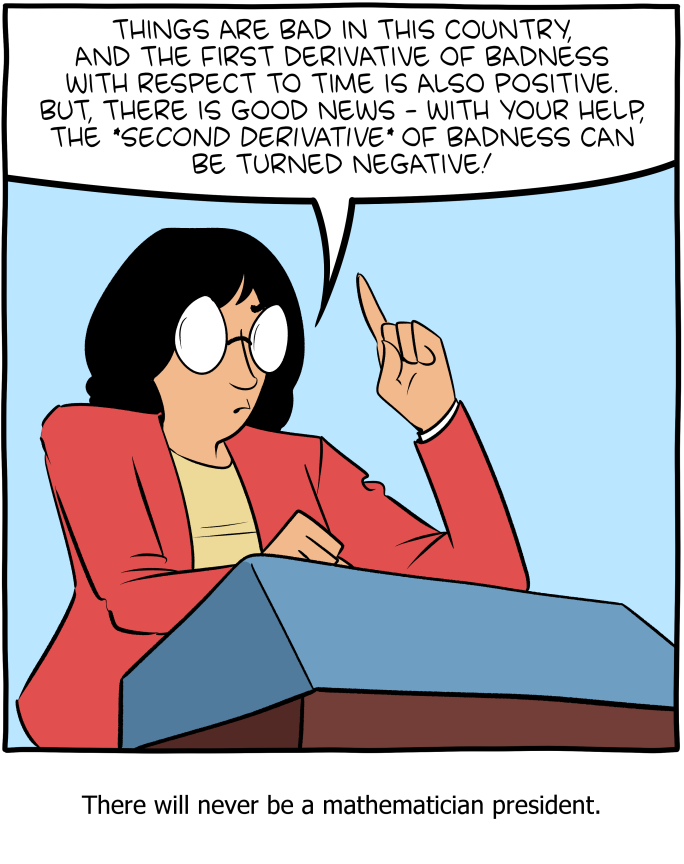
A woman who appears to be a political candidate is giving a speech: "Things are bad in this country, and the first derivative of badness with respect to time is also positive. But, there is good news -- with your help, the second derivative of badness can be turned negative!" The caption below reads: "There will never be a mathematician president."
The comic translates a standard political stump speech into calculus. In plain English, the candidate is saying: "Things are bad and getting worse. But with your help, we can slow down the rate at which things are getting worse." The first derivative of badness being positive means badness is increasing over time. The second derivative being negative means the rate of increase is slowing down -- things are still getting worse, but less quickly. This is mathematically accurate but politically disastrous, because no voter wants to hear "elect me and things will still get worse, just more slowly."
The Humor
The comedy comes from the collision between mathematical honesty and political rhetoric. Politicians routinely make promises that, if stated precisely, would amount to something like "I'll slow the rate of decline" -- but they dress this up in optimistic language like "turning things around." A mathematician would be constitutionally incapable of this kind of spin. The phrase "the second derivative of badness can be turned negative" is technically a promise of improvement, but it sounds terrible because it requires the listener to understand calculus to find any hope in it, and even then the hope is pretty bleak. The caption's deadpan verdict -- "There will never be a mathematician president" -- lands as both a joke about mathematical communication skills and a commentary on the inherent tension between precision and persuasion in politics.
References
- In calculus, the first derivative measures the rate of change, and the second derivative measures the rate of change of the rate of change. A negative second derivative with a positive first derivative means the function is still increasing but is concave down -- it is rising more slowly and may eventually peak.