bed
Explanation
The Joke
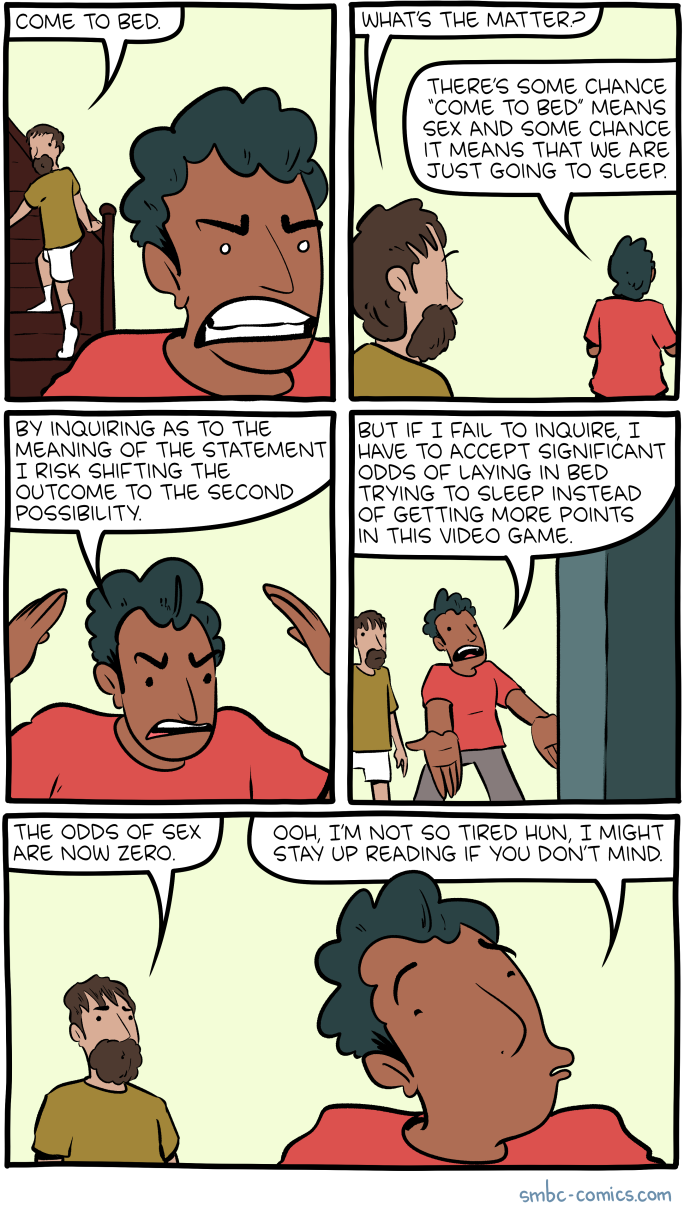
A couple is getting ready for bed. One partner says "Come to bed," and the other asks "What's the matter?" The second partner then lays out a probabilistic dilemma: there's some chance that "come to bed" means sex, and some chance it just means sleep. By agreeing to come to bed, they're implicitly consenting to the possibility of either outcome.
The overthinking partner applies decision theory: it's insulting to be invited to the possibility of sex and then just sleep, but it's also bad to assume sex and be wrong. They suggest that Bayesian reasoning leads to the conclusion that the odds favor sleep, so they might as well stay up playing video games. The other partner flatly states: "The odds of sex are now zero." The first partner cheerfully responds: "OK, I'm not so tired. Mind if I stay up reading? If you don't mind."
The Humor
The comic satirizes the tendency to overthink simple social situations using probability theory and game theory. The partner essentially talks themselves out of both sex and sleep by treating an intimate moment as a decision-theory problem. The irony is that by trying to optimize the outcome, they guarantee the worst one — no sex and a mildly annoyed partner.
The final panel is the perfect punchline: once the uncertainty is resolved (sex is definitively off the table), the overthinker is perfectly content, because now they can make a clear decision. They preferred certainty over the best possible outcome.
Broader Context
This is a classic SMBC format — applying formal reasoning (Bayesian inference, game theory, expected value calculations) to mundane relationship situations with comically counterproductive results. It pokes fun at the "rationalist" mindset where every human interaction becomes an optimization problem, often at the expense of actual human connection.