bee-vision
Explanation
The Joke
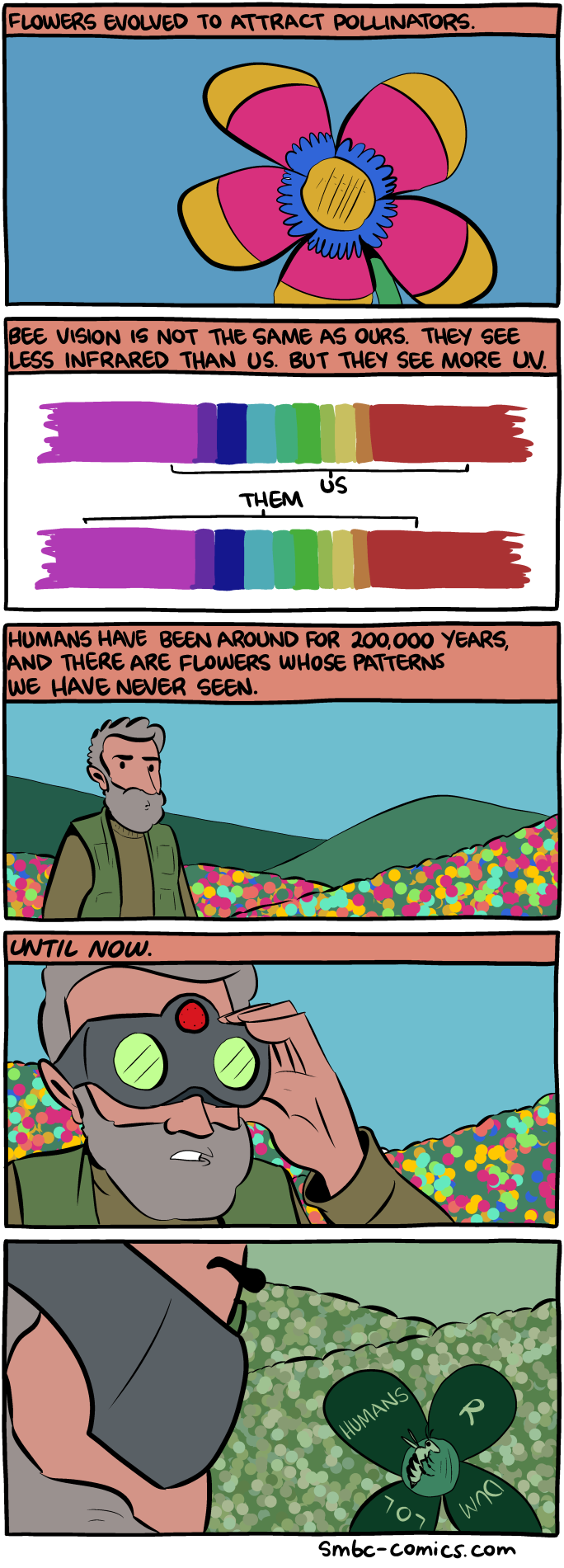
The comic presents a science-educational sequence: flowers evolved to attract pollinators, and bee vision is not the same as human vision -- bees see less infrared but more ultraviolet. It shows a comparison of color spectra as seen by bees versus humans, and illustrates that flowers have UV patterns invisible to humans. Then it notes that "humans have been around for 200,000 years and there are flowers whose patterns we have never seen" -- until now. The final panel shows a man looking through special goggles at a field of flowers, seeing their hidden UV patterns, and reacting with wonder.
The Humor
This comic is more wonder-driven than joke-driven, which is a mode SMBC occasionally adopts. The humor is gentle and comes from the awe of the situation: there are beautiful patterns literally all around us that we cannot see because our eyes did not evolve to detect ultraviolet light. Flowers have been "showing off" for bees in ways that are completely invisible to humans for our entire existence as a species.
The final image of a person seeing these hidden patterns for the first time -- essentially seeing flowers the way a bee does -- captures a sense of childlike wonder. The punchline is not a laugh line but an emotional one: the idea that reality contains hidden beauty that we are only now, after 200,000 years, able to perceive with the aid of technology. It is a celebration of science as a means of expanding human experience beyond our biological limitations.
References
The comic is based on real science. Bees can see ultraviolet light (wavelengths of roughly 300-400 nanometers), which is invisible to humans. Many flowers have UV patterns called "nectar guides" or "bee guides" -- markings that are invisible to the human eye but serve as landing strips or targets directing pollinators to the nectar. These patterns can be photographed using UV-pass filters and have been extensively documented in botanical research.