Beowulf
Explanation
The Joke
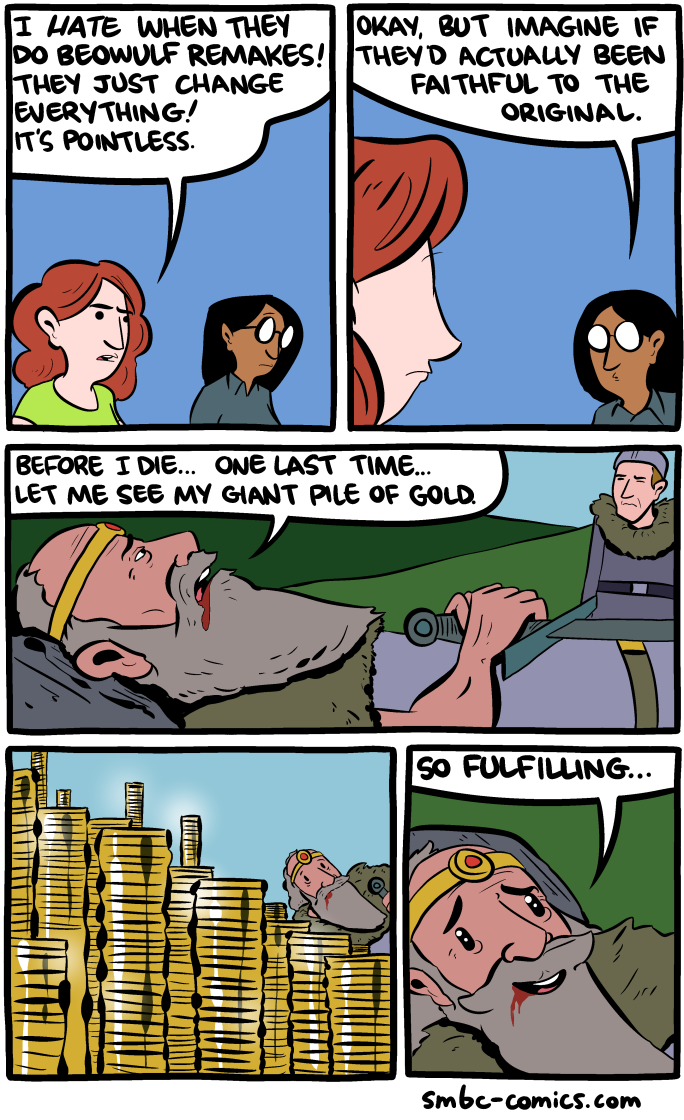
A woman complains about Hollywood remakes: "I hate when they do dishonest remakes! They just change everything! It's pointless." A man responds: "Okay, but imagine if they'd actually been faithful to the original." The scene then cuts to a faithful adaptation of Beowulf, where the dying hero says his last words: "Before I die... one last time... let me see my giant pile of gold." He gazes at an enormous heap of treasure and says "So fulfilling..."
The Humor
The comic satirizes the common complaint that Hollywood adaptations are unfaithful to their source material. In this case, a truly faithful adaptation of Beowulf would be deeply unsatisfying to modern audiences because the values of the original epic poem are alien to contemporary sensibilities. In the actual Old English poem, Beowulf is motivated significantly by treasure, glory, and material reward — his final wish involves his gold hoard. A modern audience expects dying heroes to have emotional final moments about love, sacrifice, or meaning — not to gaze lovingly at a pile of gold. The joke suggests that sometimes Hollywood changes things because the originals, taken literally, would not resonate with modern viewers. The "faithfulness" complaint sounds principled until you realize what faithfulness would actually look like.
References
Beowulf is an Old English epic poem, one of the most important works of Anglo-Saxon literature, dating to sometime between the 8th and 11th centuries. In the poem, Beowulf is a hero who fights monsters (Grendel, Grendel's mother, and a dragon). He dies fighting the dragon and, in the original text, does indeed ask to see the dragon's treasure hoard before he dies. Notable film adaptations include the 2007 Robert Zemeckis motion-capture film, which took significant liberties with the source material.