best-things
Explanation
This comic deconstructs the common saying "the best things in life are free."
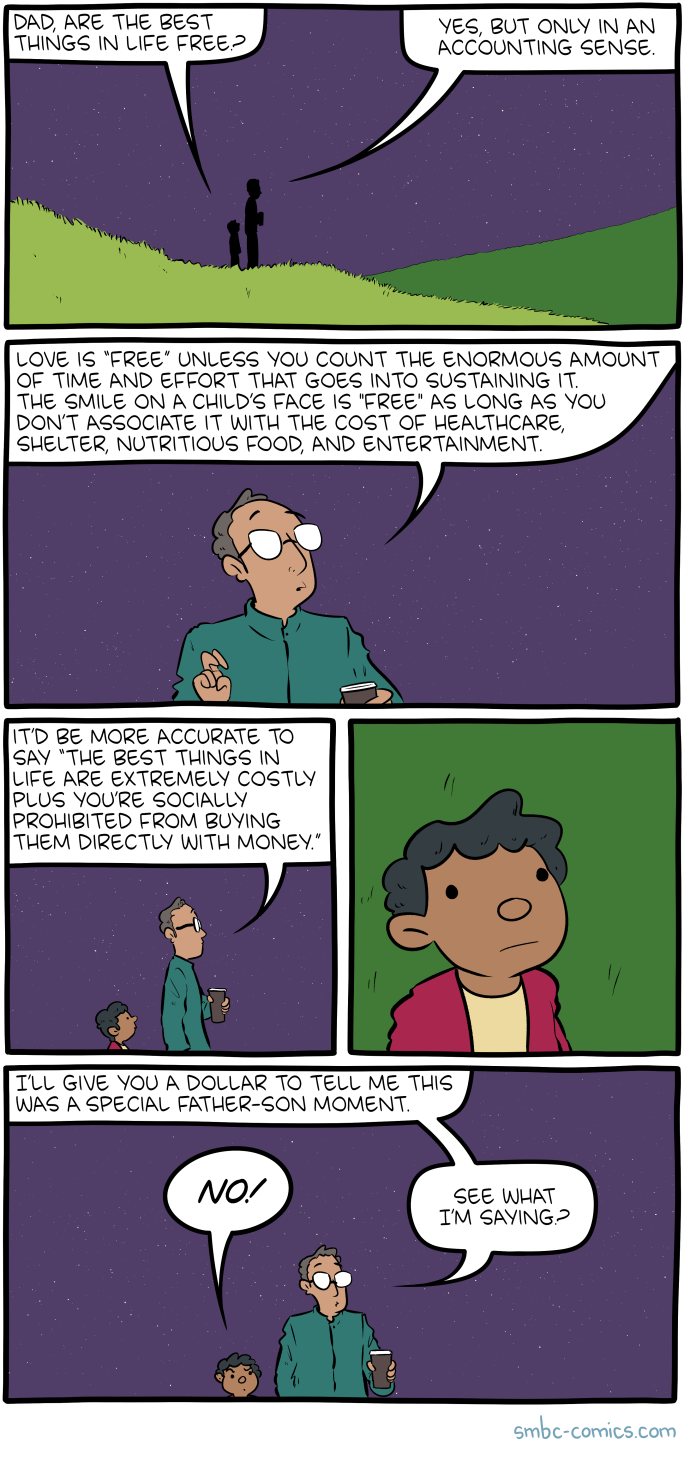
In the first panel, one character says: "Dad, are the best things in life free?" The father responds: "Yes, but only in an accounting sense."
In the second panel, the father elaborates: "Love is 'free' unless you count the enormous amount of time and effort that goes into sustaining it. The smile on a child's face is 'free' as long as you don't factor in the cost of healthcare, shelter, nutritious food, and entertainment."
In the third panel, the father continues: "It'd be more accurate to say the best things in life are costly outputs from processes you're socially required to engage in, but which often yield diminishing returns over time."
In the final panel, the child says: "It's like you're trying to tell me this was a special father-son--" The father cuts him off: "No!" while the child says: "See what I'm saying?"
The joke systematically dismantles the sentimental platitude by applying economic and accounting logic. The father distinguishes between the "price" of something (what you pay in cash) and its true "cost" (including time, effort, opportunity costs, and indirect expenses). By this analysis, love and family are technically "free" only if you ignore the enormous investments they require.
The punchline adds another layer: the child tries to point out that their very conversation is an example of one of those "best things in life" (a meaningful father-son moment), but the father is so committed to his cynical economic analysis that he refuses to acknowledge it. The irony is that the father is inadvertently providing exactly the kind of priceless-but-costly human connection he's been debunking -- he's investing time and effort into a relationship with his child even while arguing that such investments aren't truly "free."
This is a classic SMBC structure: taking a simple, feel-good idea and subjecting it to rigorous (and humorously pedantic) logical analysis.