best

Explanation
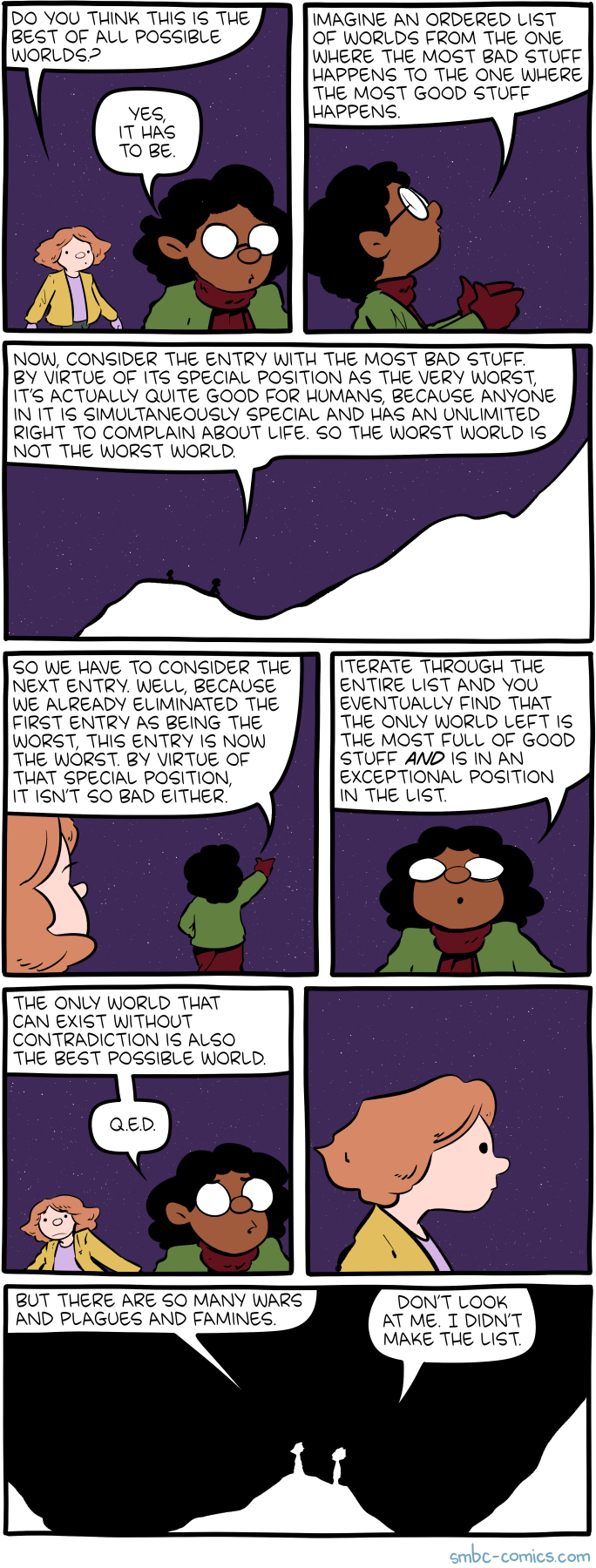
This comic presents a philosophical argument that arrives at the paradoxical conclusion that this is the best of all possible worlds -- a playful engagement with Leibniz's famous (and widely mocked) optimistic theodicy.
A philosopher proposes imagining an ordered list of all possible worlds, from worst to best. She notes that the worst world isn't simply one where nothing good ever happens, because that world would be boringly consistent. True misery requires the possibility of good outcomes -- hope, near-misses, and dashed expectations make suffering worse.
She then considers the entry with "the most bad stuff" and argues that by virtue of its spectacularly comprehensive awfulness, it becomes remarkable, even "gratuitously special," and therefore contains a kind of perverse wonder. This means it's not truly the worst world either. By iterating this argument -- each candidate for "worst" gets eliminated because its very extremity gives it a redeeming quality -- she concludes that every world on the "bad" end of the list eventually gets reclassified.
The logical conclusion: the only world that doesn't contain a self-canceling contradiction is the best possible world. Therefore, we must live in it. QED.
Her companion dryly objects: "But there are so many wars and plagues and famines." The philosopher's devastating reply: "I don't look at the worst entries on the list." This undercuts the entire argument by revealing it as an exercise in selective attention and intellectual avoidance rather than genuine reasoning. The comic parodies how clever philosophical arguments can be used to dismiss real suffering.