better-than-pi
Explanation
The Joke
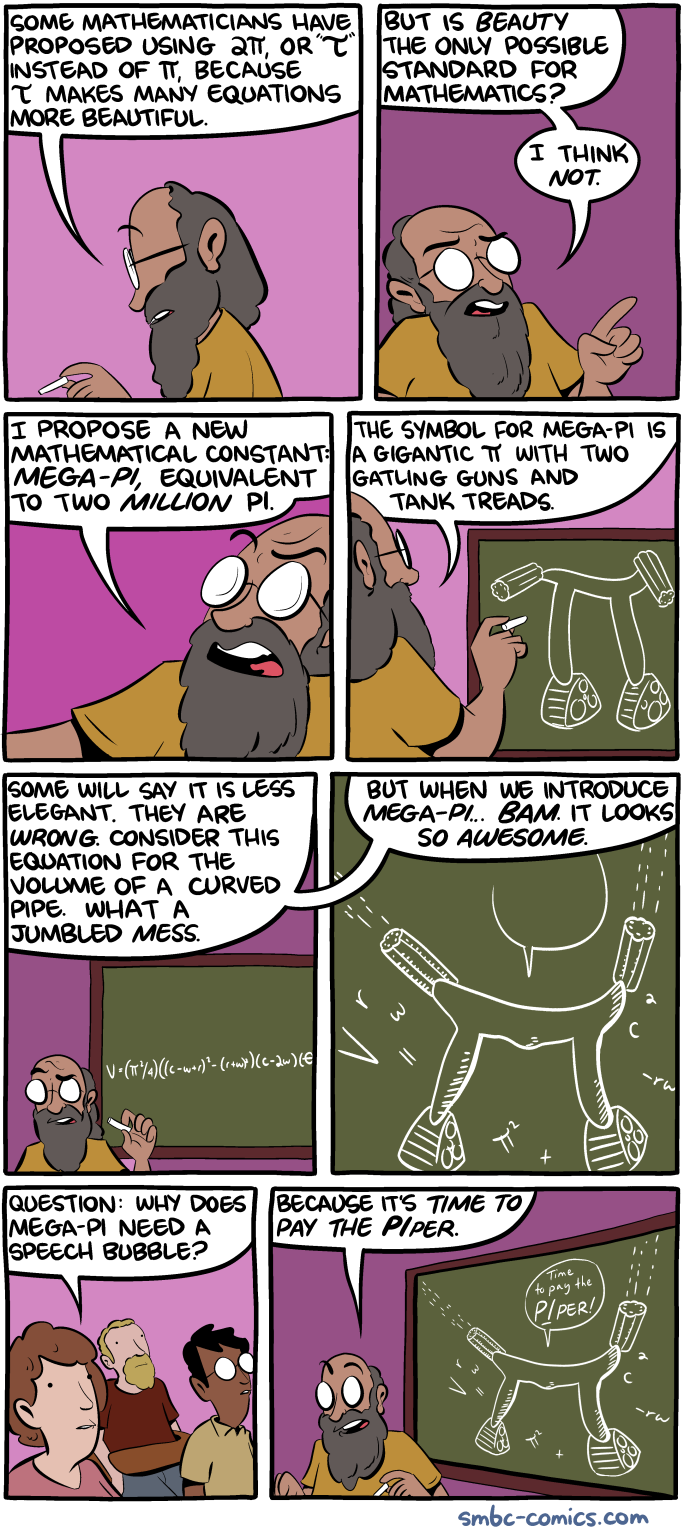
A mathematician (who looks like an ancient Greek scholar) notes that some mathematicians have proposed using tau (equal to 2 times pi) instead of pi, because it makes many equations more beautiful. He asks: "But is beauty the only possible standard for mathematics?" and answers his own question: "I think not."
He proposes a new mathematical constant called "Mega-pi," whose symbol is a drawing of a muscular figure. Mega-pi is equivalent to two million pi. He claims that while some may say it is "less elegant," when you introduce Mega-pi into equations, "it looks so awesome." The equation shown with the muscular Mega-pi symbol replacing conventional notation looks absurd but visually impressive due to the buff symbol.
In the final panel, someone asks why the Mega-pi symbol needs a speech bubble, and the mathematician replies "Because it is time to flex the math."
The Humor
The comic satirizes the ongoing "pi vs. tau" debate in mathematics. Tau (equal to 2 times pi, approximately 6.28) has been advocated by some mathematicians like Michael Hartl as a more natural circle constant. The argument is usually about elegance and beauty in equations. Weinersmith takes this aesthetic argument to its absurd conclusion: if we are choosing constants based on how they look, why not pick a constant that looks physically impressive?
The idea of a mathematical constant whose symbol is a muscular figure -- and whose value is chosen not for mathematical utility but for looking "awesome" -- perfectly skewers the sometimes subjective nature of debates about mathematical notation. The joke works because there is a kernel of truth: the choice between pi and tau really is partly aesthetic, and the comic simply takes that aesthetic criterion to a ridiculous extreme.
References
The pi vs. tau debate is a real ongoing discussion in mathematics. Michael Hartl published "The Tau Manifesto" in 2010, arguing that tau = 2*pi is the more fundamental circle constant. Pi Day is celebrated on March 14 (3/14), while Tau Day falls on June 28 (6/28). The debate touches on genuine questions about mathematical pedagogy and notation, though it is often conducted with a degree of humor and tongue-in-cheek advocacy.