bias
Explanation
The Joke
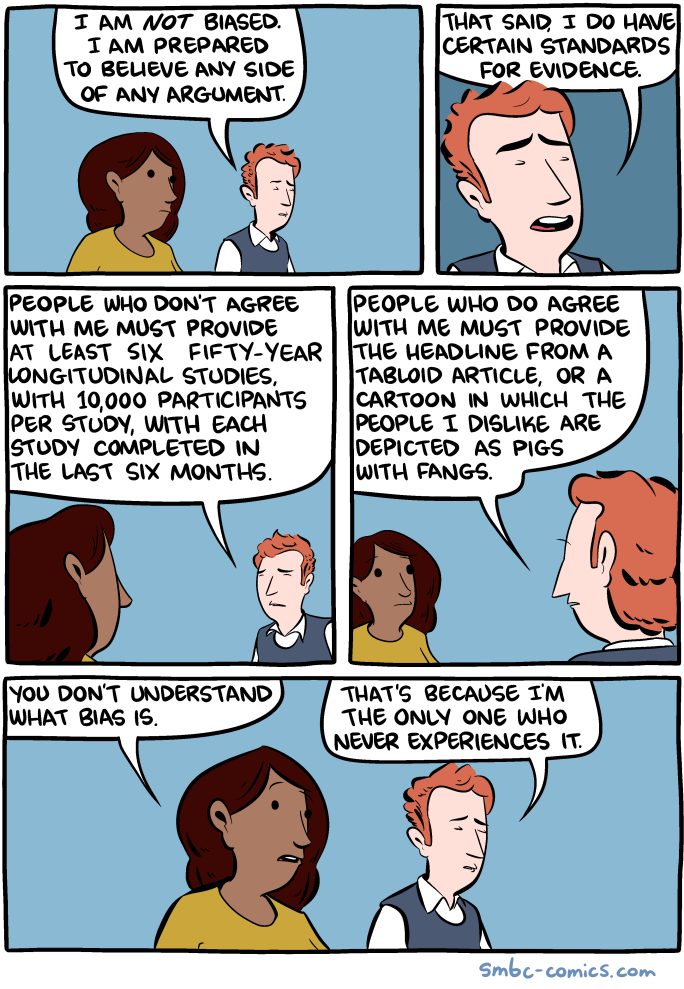
A man declares he is not biased and is prepared to believe any god or any argument, as long as there is evidence -- he says he has certain standards for evidence. He then reveals those standards: people who don't agree with him must provide at least six fifty-year longitudinal studies with 10,000 participants each, plus a study with small sample size from the last six months. Meanwhile, "people who do agree with me must provide the heading from a tabloid article, or a cartoon in which the people I dislike are drawn with big noses." When challenged with "You don't understand what bias is," he replies, "That's because I've never experienced it."
The Humor
The joke skewers the common human tendency to apply wildly different standards of evidence depending on whether information confirms or challenges our existing beliefs -- known as confirmation bias. The character claims to be perfectly rational and unbiased, but his "standards for evidence" are hilariously asymmetric: near-impossible requirements for disagreeable claims versus the lowest possible bar (a tabloid headline or a crude cartoon) for agreeable ones. The final punchline -- "I've never experienced it" -- works as a double meaning: he thinks he's saying he's never been biased, but the real joke is that he's so biased he literally cannot perceive his own bias, which is itself a well-documented cognitive phenomenon (the bias blind spot).
References
The comic references several well-known cognitive biases, including confirmation bias (seeking evidence that supports pre-existing beliefs), the bias blind spot (the tendency to see oneself as less biased than others), and motivated reasoning (applying different evidential standards based on desired conclusions).