binary
Explanation
The Joke
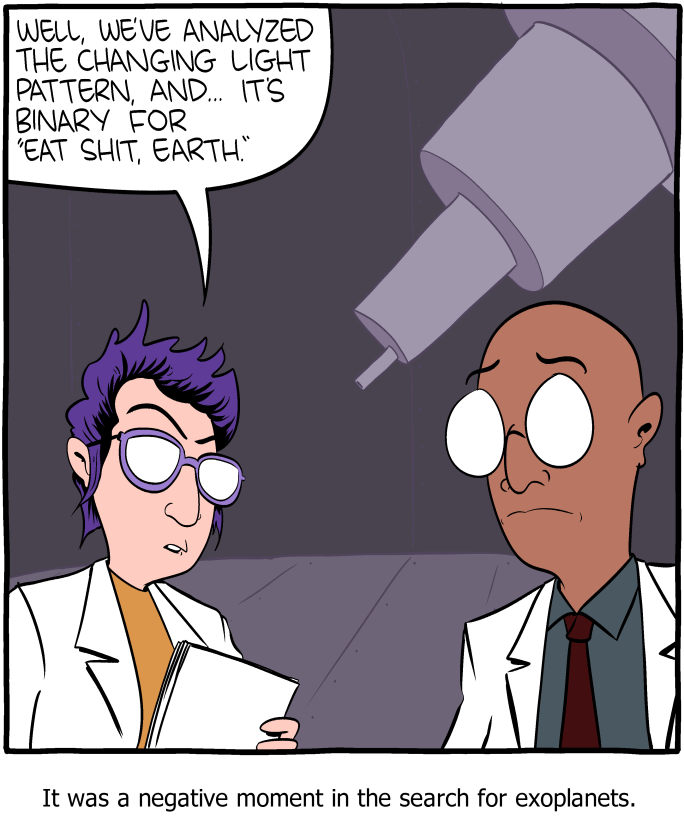
Two astronomers are standing near a telescope, and one announces that they have analyzed the changing light pattern from a distant star -- a technique used in real exoplanet detection, where periodic dimming indicates a planet passing in front of its star. However, instead of detecting the signature of a transiting planet, the light pattern decodes in binary to the message: "Eat shit, Earth." The caption reads: "It was a negative moment in the search for exoplanets."
The comic imagines that humanity's first contact with alien intelligence comes not through a hopeful SETI signal or a diplomatic greeting, but through a hostile insult encoded in the very method scientists use to search for new worlds. The aliens have apparently figured out how to modulate their star's light output just to tell Earth to go away.
The Humor
The humor comes from the collision of grand scientific ambition with juvenile vulgarity. The search for exoplanets represents one of humanity's most awe-inspiring scientific endeavors, and the idea that the first decoded alien message would be a crude insult is a perfect deflation of cosmic optimism. The understated caption -- calling this merely "a negative moment" -- adds dry humor, treating an existentially devastating discovery (hostile aliens who can manipulate stars) with the same tone as a disappointing quarterly earnings report. It also plays on the dual meaning of "negative": both bad news and the absence of a positive exoplanet detection.
References
The transit method is one of the primary techniques used to detect exoplanets, particularly by missions like NASA's Kepler and TESS space telescopes. By measuring periodic dips in a star's brightness, astronomers can infer the presence of an orbiting planet. Binary code is a base-2 number system fundamental to computing, using only 0s and 1s, which could theoretically be encoded in light patterns (on/off or bright/dim).