birth-strategy

Explanation
The Joke
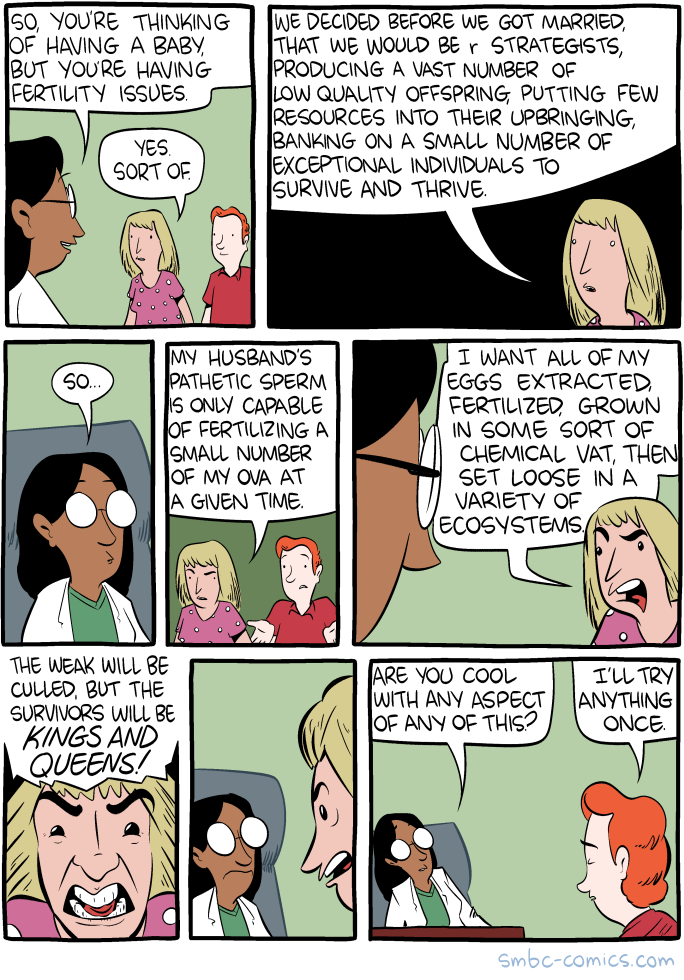
A couple visits a doctor about fertility issues. The woman explains that before they got married, they decided they would be "r strategists" -- producing a vast number of low-quality offspring, putting few resources into their upbringing, and banking on a small number of exceptional individuals to survive and thrive. The doctor is clearly taken aback.
The woman continues: her husband's "pathetic sperm" is only capable of fertilizing a small number of her ova at a time, so she wants all of her eggs extracted, fertilized, grown in some sort of chemical vat, and then "set loose in a variety of ecosystems." She declares with manic enthusiasm, "The weak will be culled, but the survivors will be kings and queens!" The horrified doctor asks her husband, "Are you cool with any aspect of this?" He cheerfully replies, "I'll try anything once."
The Humor
The comic takes the ecological concept of r/K selection theory -- which describes reproductive strategies in animals -- and applies it to human family planning with disturbing literalness. Most humans are quintessential K-strategists (few offspring, heavy parental investment), so a couple deliberately choosing the r-strategy (mass offspring, no parental care, natural selection does the rest) is horrifyingly absurd. The woman is essentially proposing to breed like a sea turtle or a frog, releasing hundreds of babies into the wild and hoping some survive.
The husband's casual "I'll try anything once" is the perfect punchline because it treats this nightmarish scheme with the same nonchalance one might use for trying a new restaurant. The doctor's growing horror serves as the audience surrogate throughout.
References
The comic references r/K selection theory from ecology, proposed by Robert MacArthur and E.O. Wilson in 1967. The theory describes a spectrum of reproductive strategies: r-strategists (like fish, frogs, and insects) produce many offspring with little parental investment, relying on sheer numbers for some to survive; K-strategists (like elephants, whales, and humans) produce few offspring with heavy parental investment. While the theory has been somewhat superseded by more nuanced models of life history theory, the r/K framework remains widely taught and understood.