border
Explanation
The Joke
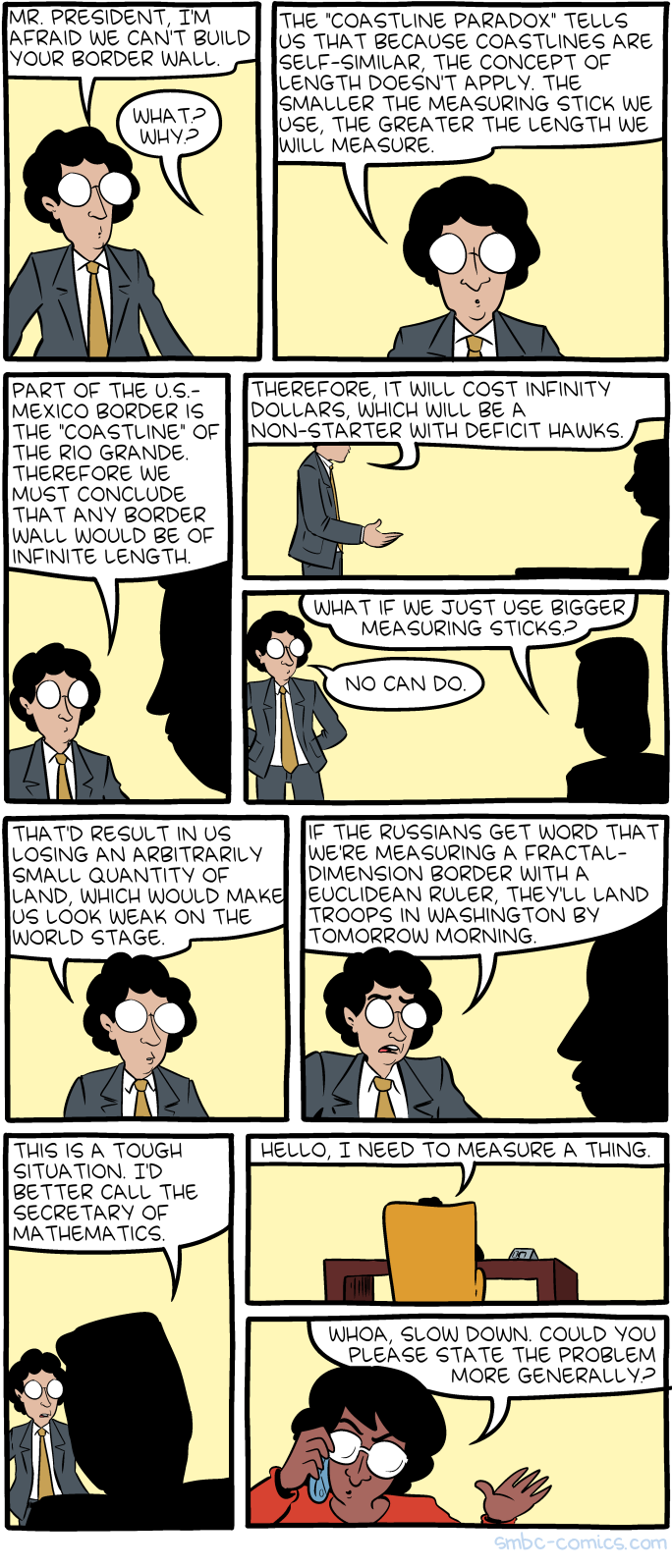
The comic takes the political debate about building a border wall and derails it with a mathematical paradox. A character argues that they cannot build a border wall because of the "coastline paradox" -- the real-world observation that the measured length of a coastline depends on the scale of measurement used. The smaller the measuring unit, the longer the coastline becomes, because you capture more and more fine-grained irregularities. Applied to the US-Mexico border, this means the border's length is theoretically dependent on the resolution of your measuring stick.
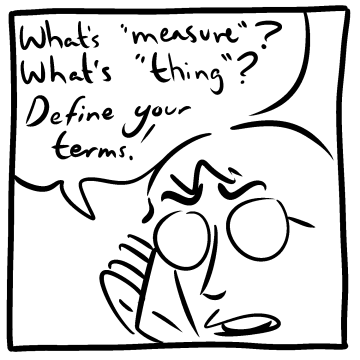
The conversation escalates as the characters discuss the implications: if they are measuring a fractal-like border using a Euclidean ruler, the length approaches infinity, which would make the wall infinitely expensive. An opponent concedes it is a "tough question" and suggests they consult a mathematician. In the final panel, the mathematician, when asked to help, responds with the classic academic deflection: "Maybe I need to measure a thing" -- suggesting even the expert is going to get lost in the theoretical rabbit hole rather than providing a practical answer.
The Humor
The comedy comes from weaponizing an obscure mathematical concept (the coastline paradox) to derail a straightforward political argument. The absurdity of someone blocking a multi-billion-dollar infrastructure project by invoking fractal geometry is inherently funny, especially because the underlying mathematics is real and genuinely fascinating. The comic also satirizes how experts can sometimes make simple problems seem impossibly complex, and how both sides of a political debate will reach for increasingly arcane arguments to support their positions. The final panel, with the mathematician getting absorbed in measurement theory rather than answering a yes-or-no question, is a classic jab at academic impracticality.
References
The coastline paradox is a real concept first described by mathematician Lewis Fry Richardson and later popularized by Benoit Mandelbrot in his work on fractal geometry. The paradox demonstrates that coastlines and borders are effectively fractal in nature -- their measured length increases as the measurement scale decreases. Mandelbrot's famous 1967 paper "How Long Is the Coast of Britain?" is the seminal work on this topic.