Bored
Explanation
The Joke
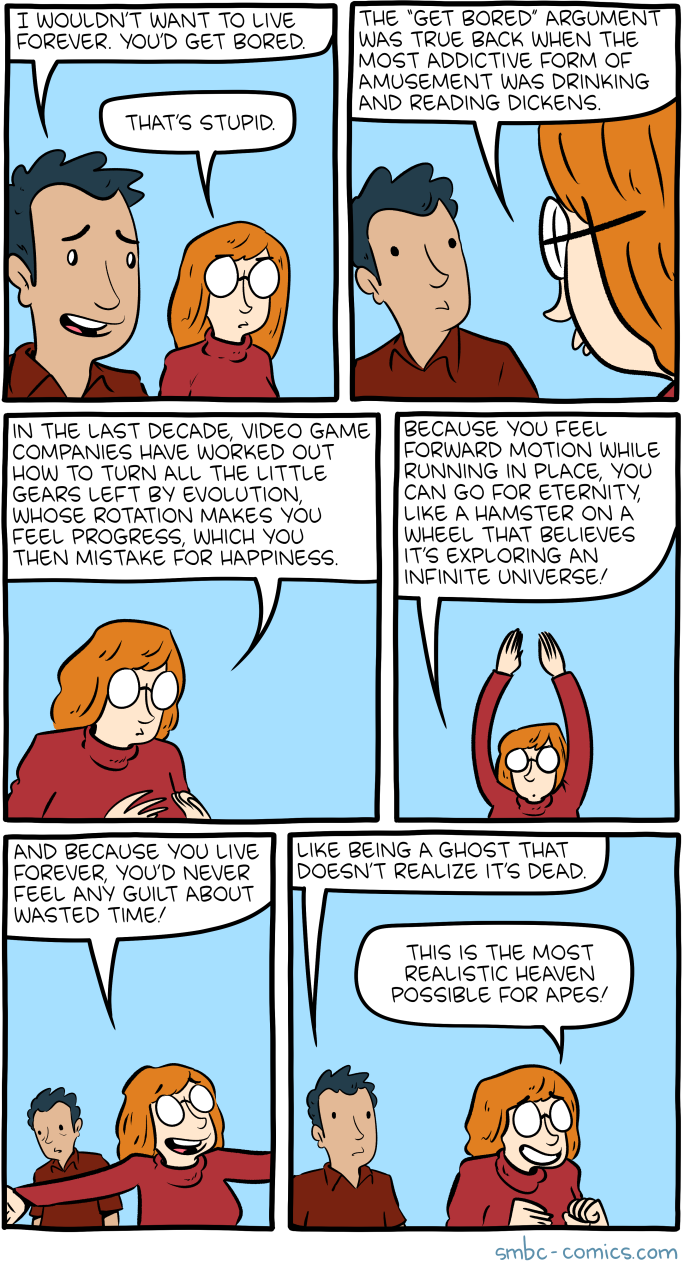
A man tells a woman he wouldn't want to live forever because "you'd get bored." She dismisses this as stupid, and then launches into a detailed rebuttal. She points out that in the last decade, video games alone have taught us that giving humans a little avatar to control with simple goals and progression makes them feel purpose, "then mistaking it for happiness." She argues that you could spend eternity essentially running in place, doing pointless activities, and never get bored because you'd always believe you were doing something meaningful in an infinite universe.
She then adds that even if you somehow did get bored, "you'd never know because you'd have no memory of wasted time." In the final panel, the man observes that she is "being a robot that doesn't realize it's dead," and the woman responds, "This is the most realistic neural possible for an NPC."
The Humor
The comedy works on multiple levels. On the surface, it's a funny reversal of the typical philosophical objection to immortality. Instead of thoughtfully engaging with the boredom argument, the woman demolishes it by essentially arguing that humans are so easily tricked by simple reward loops (like video games) that boredom would never be a real problem -- we'd just keep ourselves occupied with meaningless busywork and mistake it for fulfillment. The darker layer of humor is that this argument accidentally describes how most people already live their finite lives, making the "boredom" objection to immortality seem doubly absurd. The final panel adds a meta twist suggesting the characters themselves may be NPCs or simulated beings, collapsing the philosophical argument into an existential joke.
References
The comic references the philosophical debate about whether immortality would be desirable, famously explored by Bernard Williams in his essay "The Makropulos Case: Reflections on the Tedium of Immortality." It also touches on concepts from game design about engagement loops and the psychology of reward systems, as well as simulation theory and the philosophical zombie (p-zombie) thought experiment.