bound-2
Explanation
The Joke
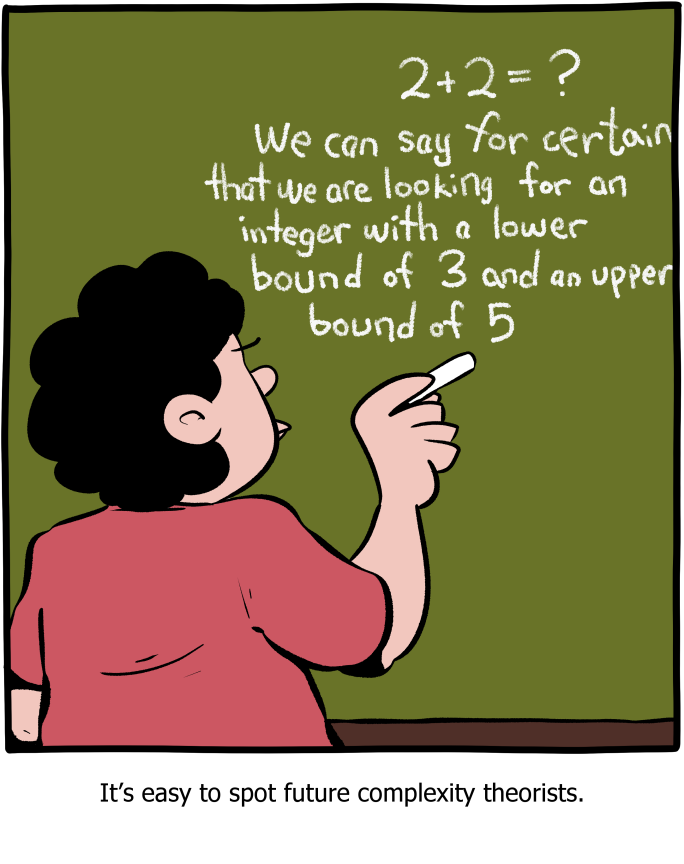
A teacher stands at a chalkboard with "2+2 = ?" written on it. Instead of answering "4," the teacher writes: "We can say for certain that we are looking for an integer with a lower bound of 3 and an upper bound of 5." The caption reads: "It's easy to spot future complexity theorists."
The Humor
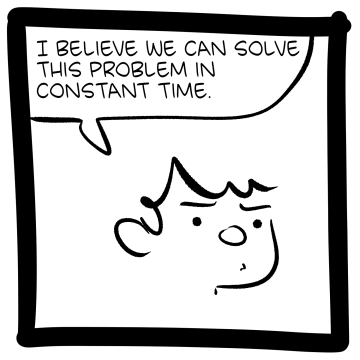
The comic jokes about how complexity theorists approach problems differently from normal people. Rather than simply computing the answer to 2+2, this student (or teacher demonstrating the mindset) provides asymptotic bounds on the answer — stating that the result is at least 3 and at most 5. This is technically correct (4 does indeed fall between 3 and 5) but absurdly unhelpful for such a trivial problem.
In computational complexity theory, researchers often work with problems where exact solutions are intractable, so they focus on establishing upper and lower bounds. Proving that an answer or running time is "at least X but no more than Y" is a major result in the field, even when the bounds aren't tight. The joke is that this child is already thinking in this framework at the most elementary level of arithmetic — treating 2+2 as if it were an open research problem where narrowing the bounds is an achievement, rather than just computing the answer directly.