bound
Explanation
The Joke
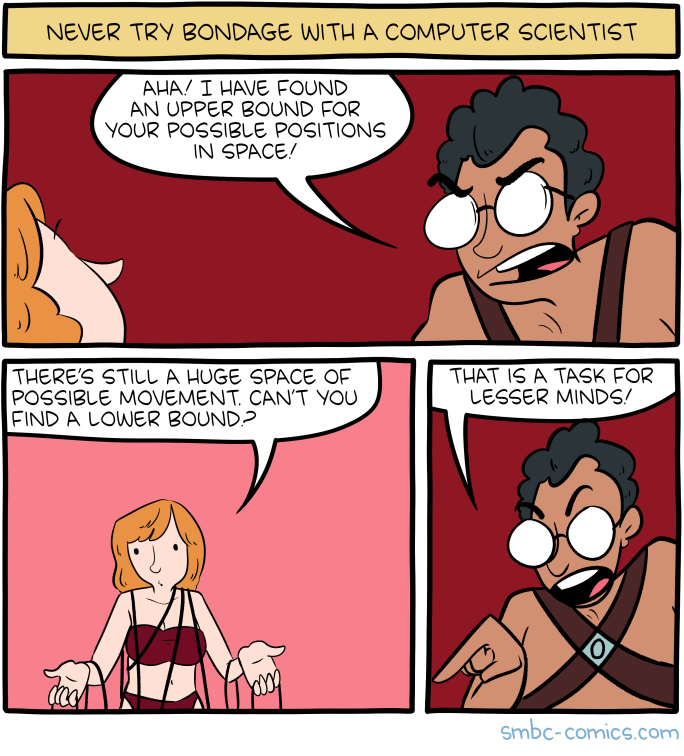
The comic is titled "Never try bondage with a computer scientist." A woman in lingerie stands in a bedroom scene, apparently ready for some kinky roleplay. The computer scientist partner, instead of engaging romantically, announces: "Aha! I have found an upper bound for your possible positions in space!" The woman responds with dismay. In the final panel, the computer scientist proudly declares, "There's still a huge space of possibilities, but I managed to find a lower bound!" and the woman retorts, "That is a turn for lesser minds" (or similar dismissive response).
The comic takes the setup of a bondage/BDSM scenario and subverts it entirely. Instead of being interested in the physical or romantic aspects, the computer scientist treats the constrained person as a computational problem -- specifically, a constraint satisfaction or optimization problem where they are trying to determine the "bounds" on the set of possible positions.
The Humor
The humor relies on a double meaning of "bound" and "bondage." In BDSM, being "bound" means being physically restrained. In computer science and mathematics, "bounds" refer to limits on a set of possible values -- upper bounds and lower bounds are fundamental concepts in algorithm analysis and optimization. The computer scientist character is so consumed by their professional mindset that they see a romantic scenario purely as an optimization problem, completely killing the mood. The joke also plays on the stereotype of computer scientists being socially oblivious and unable to turn off their analytical thinking even in the most inappropriate contexts.
References
Upper and lower bounds are key concepts in computational complexity theory and algorithm analysis. Finding tight bounds on a problem is a central goal in theoretical computer science, such as determining Big-O (upper bound) and Big-Omega (lower bound) running times.