boy-bands
Explanation
The Joke
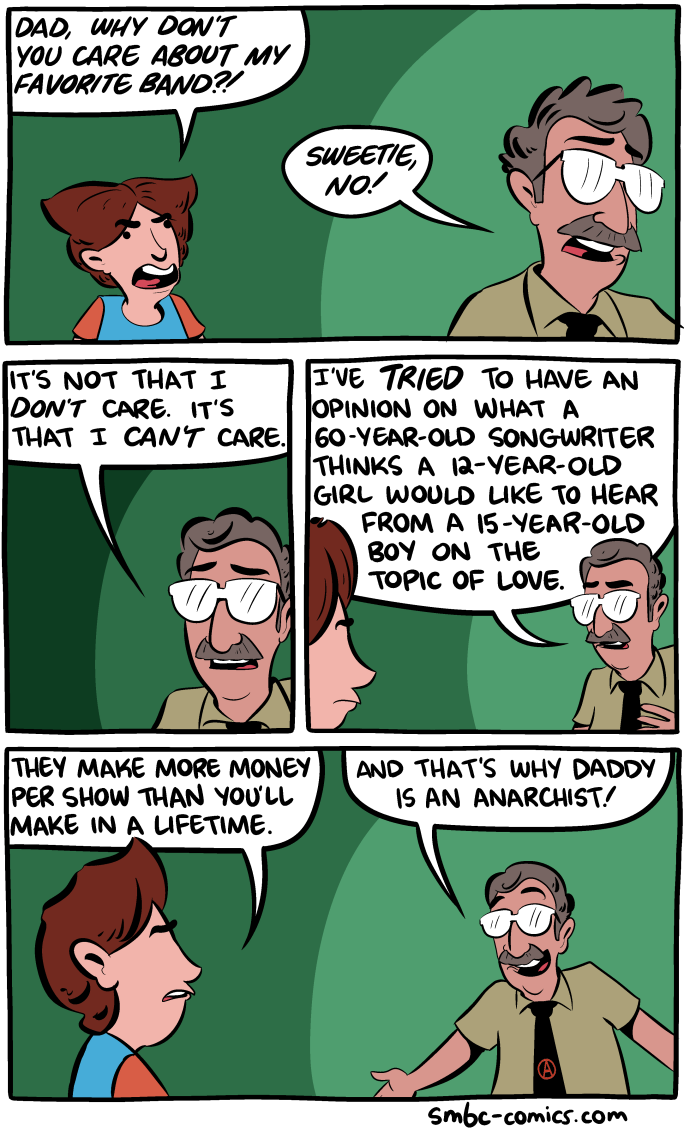
A young boy asks his father, "Dad, why don't you care about my favorite band?" The father responds, "Sweetie, no. It's not that I don't care. It's that I can't care." He explains: "I've tried to have an opinion on what a 60-year-old songwriter thinks a 10-year-old girl would like to hear from a 15-year-old boy on the topic of love."
The father then adds: "They make more money per show than you'll make in a lifetime." The final panel delivers the punchline: "And that's why daddy is an anarchist."
The Joke
The comic deconstructs the boy band phenomenon with ruthless precision. The father's complaint is not that boy band music is bad in some vague way, but that it is an absurd chain of artificial mediation: an older adult songwriter imagining what a preteen girl wants to hear, filtered through the performance of a teenage boy, on a subject (love) that none of them have relevant experience with. The product is so many layers removed from authentic expression that the father literally cannot form an opinion about it.
The escalation to anarchism is the punchline -- the father's frustration is not just aesthetic but economic and political. The fact that this manufactured, inauthentic product generates more wealth per show than his child will earn in an entire lifetime drives him to reject the entire economic system. It is a comedic overreaction, but it is grounded in a real observation about how capitalism rewards manufactured cultural products over authenticity or labor.
The Humor
The humor comes from the escalation: a simple question about a child's taste in music spirals into an existential crisis about capitalism, authenticity, and the nature of cultural production. The father's carefully analytical breakdown of why boy bands are philosophically impossible to care about is funny because it applies rigorous logic to something most parents dismiss with a simple eye-roll. The leap to anarchism as a political response to boy band economics is the comedic capstone -- it is simultaneously absurd and oddly sympathetic.