brain
.png)
Explanation
The Joke
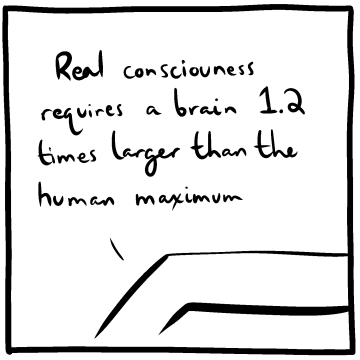
A computer is speaking to a woman, making an argument about consciousness and free will: "Think about it. You're just a collection of neurons that don't even understand what they do. When 'you' 'decide' to do something in your mind, your brain has already begun a corresponding neural process!" The computer is using well-known neuroscience arguments -- particularly the work of Benjamin Libet on readiness potentials -- to argue that human consciousness is an illusion and that free will doesn't really exist.
The caption delivers the punchline: "In the Advanced Turing Test, the machine convinces you that it's conscious and you aren't." The traditional Turing Test asks whether a machine can convince a human that the machine is intelligent. This "advanced" version flips the script: the machine doesn't just prove its own consciousness -- it actively undermines the human's belief in their own consciousness.
The Humor
The comic is funny because it takes a real philosophical and neuroscientific debate (the illusory nature of consciousness and free will) and reframes it as a competitive strategy by an AI. Instead of the machine trying to pass as human, it's trying to demote the human to the status of a mere mechanism. The woman's visible discomfort as the computer lectures her makes it clear the strategy is working. It's also a clever meta-joke: the arguments the computer is using are ones that actual human philosophers and scientists make, so in a sense, humans have already been doing the machine's work for it.
References
- The Turing Test was proposed by Alan Turing in 1950 as a measure of machine intelligence.
- Benjamin Libet's experiments in the 1980s showed that brain activity associated with voluntary decisions (the "readiness potential") begins before a person is consciously aware of deciding, sparking ongoing debates about free will.