butterfly
Explanation
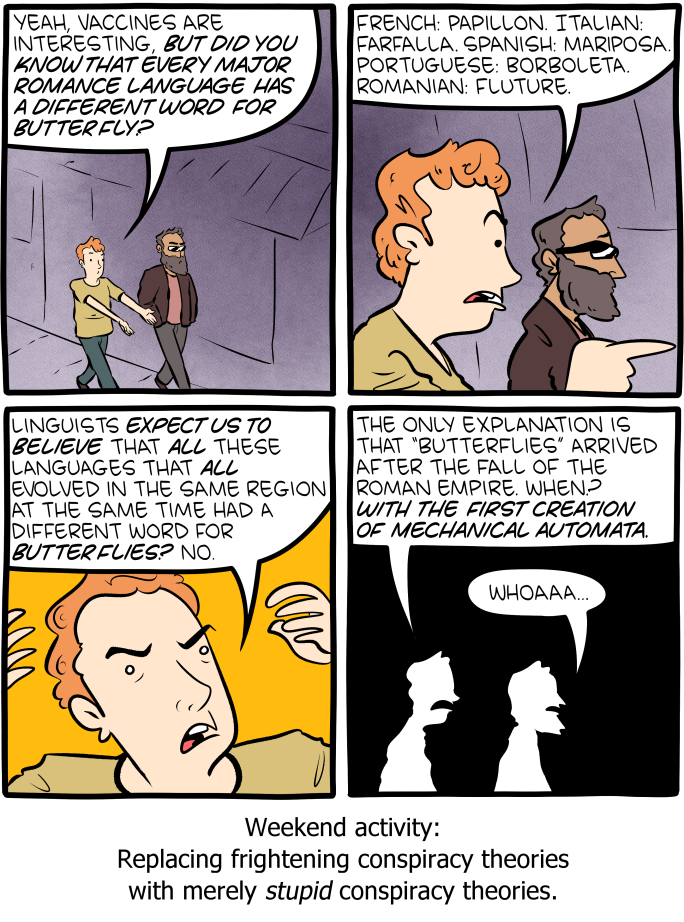
This comic plays on conspiracy theories about Romance languages and their shared vocabulary, turning a real and well-understood linguistic phenomenon into a fake but more entertaining conspiracy theory.
In the first panel, a character makes an observation: "Yeah, vaccines are interesting, but did you know that every major Romance language has the same word for butterfly?" The second panel lists examples: French "papillon," Italian "farfalla," Spanish "mariposa," Portuguese "borboleta" -- noting they are all completely different words. This is actually true: unlike most basic vocabulary in Romance languages (which share obvious Latin roots), the word for "butterfly" is strikingly different across these languages.
The character then suggests people "expect, if you believe languages all come from one region, languages that all share roots..." but the butterfly words are "different words for the same basic thing." The explanation given is that the only explanation is that "Romance languages independently evolved after the fall of the Roman empire due to the influence of mechanical automata" -- an absurd conspiracy theory.
The final panel shows silhouettes watching an explosion ("WHOAA"), and the caption reads: "Weekend activity: Replacing frightening conspiracy theories with merely stupid conspiracy theories."
The humor works on several levels. First, the linguistic observation about butterfly words is genuinely interesting and real -- it's one of the most commonly cited oddities in comparative Romance linguistics. Second, the comic takes this real curiosity and constructs an intentionally absurd conspiracy theory around it, satirizing how conspiracy theorists latch onto genuine anomalies and construct wild explanations. Third, the punchline in the caption suggests this is actually a public service -- replacing dangerous conspiracy theories (anti-vaccine rhetoric) with harmless, silly ones. The joke implies that people have a psychological need for conspiracy theories, so rather than trying to eliminate conspiratorial thinking entirely, it might be better to redirect it toward entertaining nonsense.