calculating

Explanation
The Joke
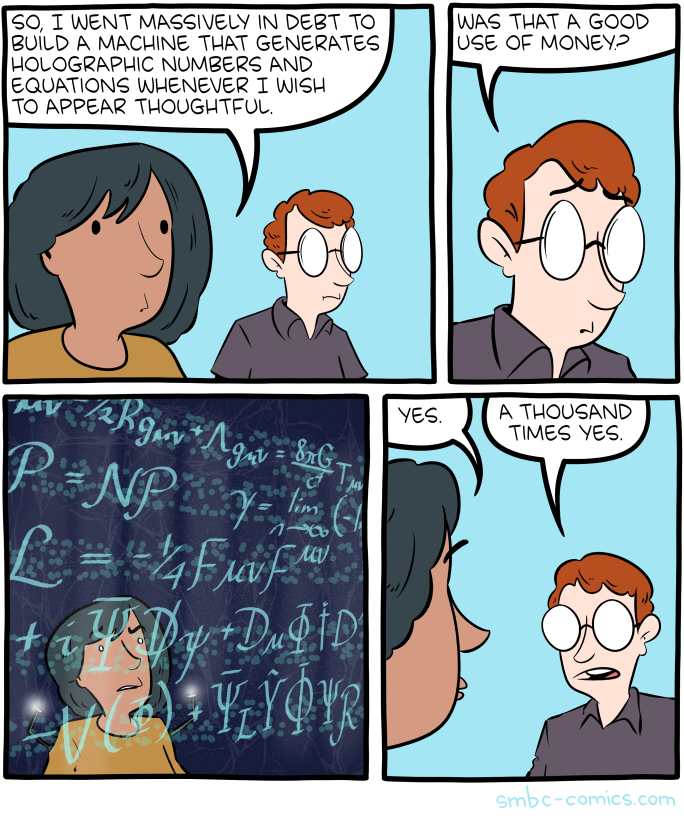
A woman tells a man that she went massively into debt to build a machine that generates holographic numbers and equations, and she wants to surprise her physicist colleagues. She asks "What do you think?" and the man enthusiastically replies "That's a good use of money!" She then asks if she should use it, and the man says "Yes, a thousand times yes."
The final panel shows her standing in front of a chalkboard covered in impressive-looking equations and formulas, with the implication that the "holographic number generator" is simply projecting random mathematical notation onto a surface to make her look smart. The joke is that the machine doesn't do any actual computation or physics -- it just generates the visual aesthetics of looking like a brilliant scientist.
The Humor
The comedy lies in the absurd misallocation of resources: going into massive debt not to solve equations or advance science, but merely to project the appearance of doing so. It satirizes the way complex-looking equations on chalkboards have become a visual shorthand for genius in popular culture. The man's over-the-top enthusiasm ("a thousand times yes") suggests he is equally taken in by the superficial appeal of "looking sciency." There is also an implicit jab at how academia sometimes values the performance of intelligence over actual results.