can

Explanation
The Joke
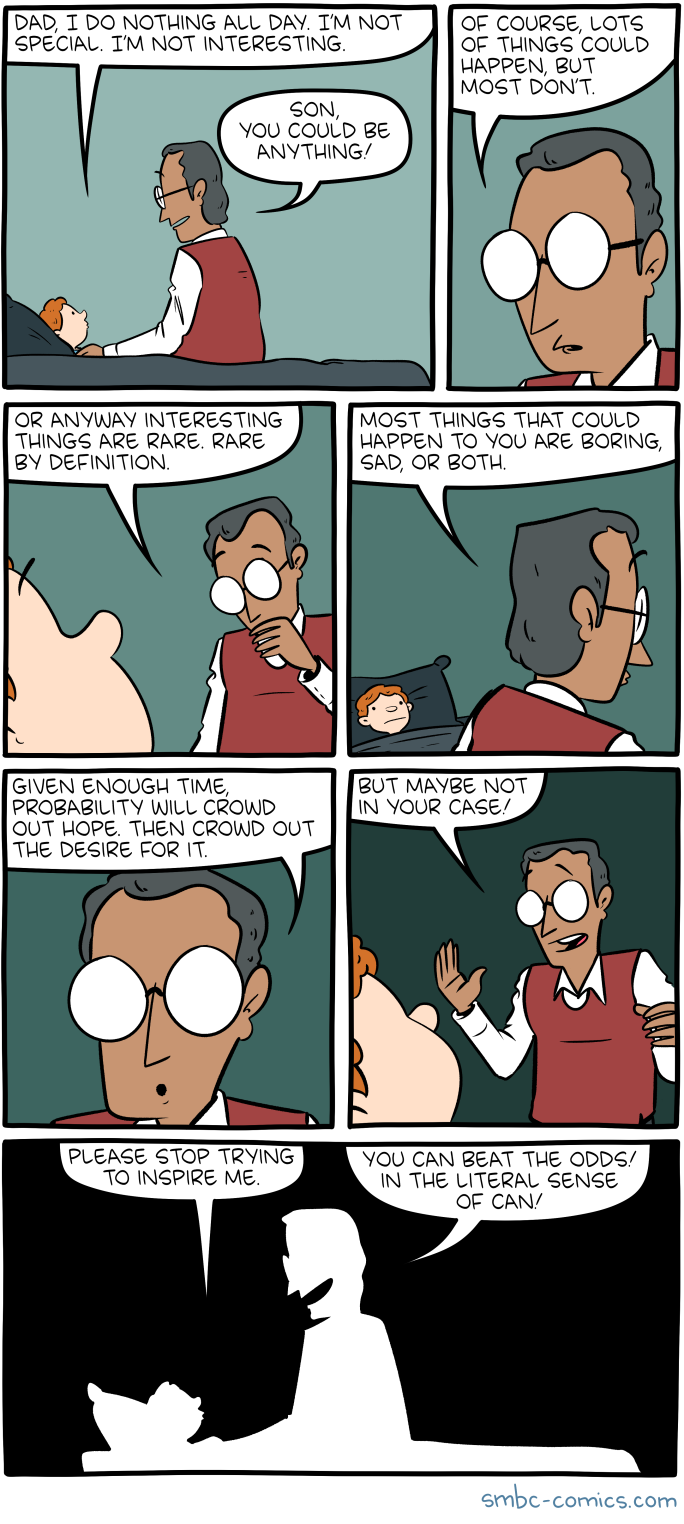
A person is eating chips and watching TV while someone else tells them, "You could be anything!" The chip-eater responds that they do nothing all day, they're not special, and they're not interesting. The other person persists, saying "You could be ANYTHING!" The chip-eater then makes a logical argument: of course lots of things could happen, but most don't. By definition, most interesting things that could happen to someone are boring or sad or both. Given enough time, probability will crowd out hope, and they should give up the dream.
The other person says, "But maybe not in your case," and the chip-eater replies: "You can beat the odds in the literal sense of easy." The final panel reveals them at a graduation podium, delivering this as a commencement speech. The punchline is that this deeply pessimistic, nihilistic monologue — which systematically dismantles every inspirational platitude — is being delivered as a graduation speech, the one context where relentless optimism and "you can be anything" rhetoric is most expected.
The Humor
The comic works by building what feels like a private conversation between a lazy person and a motivational friend, then revealing it's actually a formal public address. The humor targets the genre of inspirational commencement speeches (famously given by figures like Steve Jobs, David Foster Wallace, etc.) by showing what a statistically honest one would sound like. Every standard graduation speech trope — "you can be anything," "follow your dreams," "the odds don't apply to you" — is methodically demolished with probabilistic reasoning. The final line, "you can beat the odds in the literal sense of easy," is a clever twist: "beating the odds" usually means achieving something unlikely, but here it means the odds (of mediocrity) will beat you — and they'll do it easily.
References
- Commencement speeches: A genre of public address traditionally delivered at graduation ceremonies, known for their uplifting, aspirational tone. Famous examples include Steve Jobs' 2005 Stanford address and David Foster Wallace's "This Is Water" (2005).
- Survivorship bias: The logical error of focusing on successful outcomes while ignoring the far larger number of failures, which is implicitly what the comic critiques about "you can be anything" rhetoric.