candyland
.png)
Explanation
The Joke
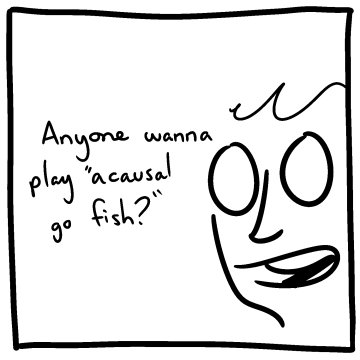
The comic shows a group of people playing a board game. One player complains: "God I hate this game. It looks like there's action and suspense, but it's all just set by the starting conditions." Another player responds: "Isn't that a philosophical determinism?" to which someone replies, "Yeah, but that's not really what it looks like on the surface." The final panel reveals the punchline: "Doesn't the same thing apply to all of foreshadowing?" -- connecting the complaint about the game to a broader observation about narrative structure.
The board game in question appears to be Candy Land, which is famously a game of zero player agency -- the entire outcome is determined by the order of the cards in the deck before the game even begins. Players simply draw cards and move; no decisions are ever made. The comic uses this as a jumping-off point for a philosophical discussion about determinism.
The Humor
The humor lies in the escalating layers of intellectual overthinking applied to a children's board game. What starts as a mundane complaint about a boring game quickly spirals into a discussion of philosophical determinism and literary theory. The observation that Candy Land is deterministic is technically true and philosophically interesting, but absurdly heavy for a game designed for small children. The final leap to questioning the nature of foreshadowing in fiction adds yet another layer, suggesting that all narrative fiction is similarly "rigged" from the start by its author -- just as Candy Land is rigged by its shuffled deck.