Cantor
Explanation
The Joke
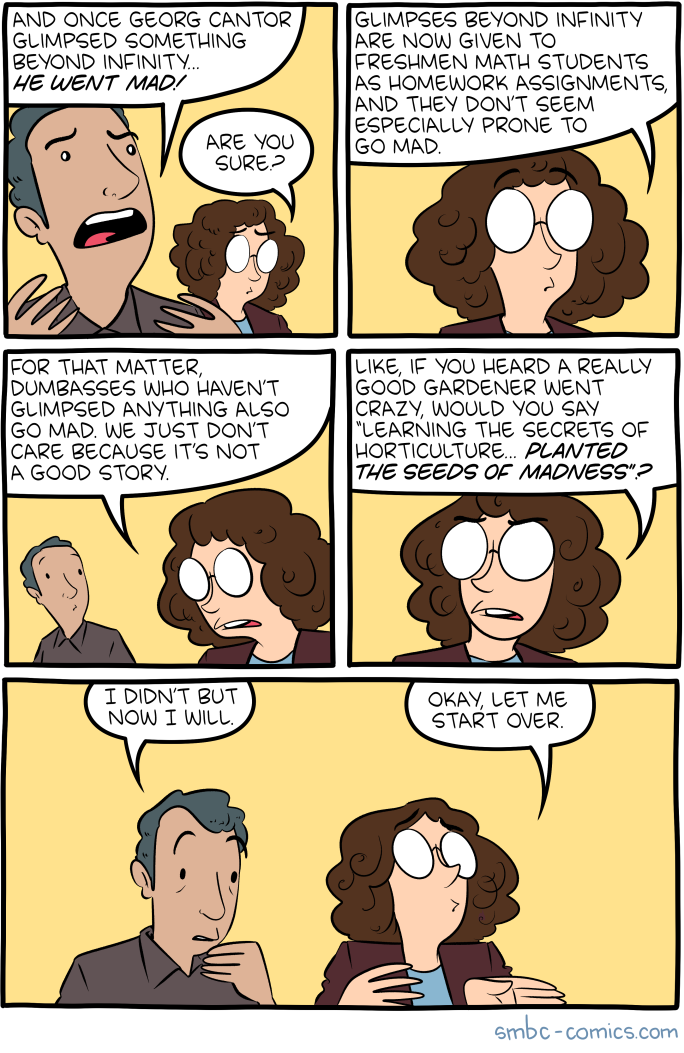
A person is enthusiastically telling the story of Georg Cantor, saying: "And once Georg Cantor glimpsed beyond infinity, glimpsed beyond all our abilities to conceive, he went mad." Another person asks "Are you sure?" The storyteller responds with the more exciting version -- that Cantor "glimpsed beyond infinity" and became "especially prone to delusions" and that his admission assignments suggest madness. But when challenged with: "Sure, if you heard a really good rumor about someone who did math with infinity, would you say 'Oh neat, he then lived a normal life' or would you say 'He peered into the infinite and paid the price -- the deeds of madness!'?" The other person admits: "I don't, but I want to." The storyteller says "Okay, let me start over."
The Humor
The comic skewers the popular myth-making around mathematicians, particularly Georg Cantor. There is a widespread romantic narrative that Cantor's work on infinity drove him insane -- that peering into the mathematical infinite broke his mind. In reality, Cantor suffered from depression that may or may not have been related to his mathematical work, and the "madness from infinity" narrative is largely an embellishment. The comic makes this point by having one character explicitly acknowledge that the dramatic version is more fun to tell and hear, even though it is not quite accurate. The honesty of "I don't [believe it], but I want to" perfectly captures how people relate to these kinds of romanticized intellectual legends.
References
Georg Cantor (1845-1918) was a German mathematician who created set theory and proved that there are different sizes of infinity (his famous diagonal argument). He did suffer from bouts of depression and was hospitalized several times. While popular accounts often attribute his mental health issues to his confrontation with the infinite, historians of mathematics have noted that his depression may have had other causes, including professional conflicts with Leopold Kronecker and personal stresses. The "mad genius" narrative has been heavily critiqued but remains persistent in popular culture.