capacity
.png)
Explanation
The Joke
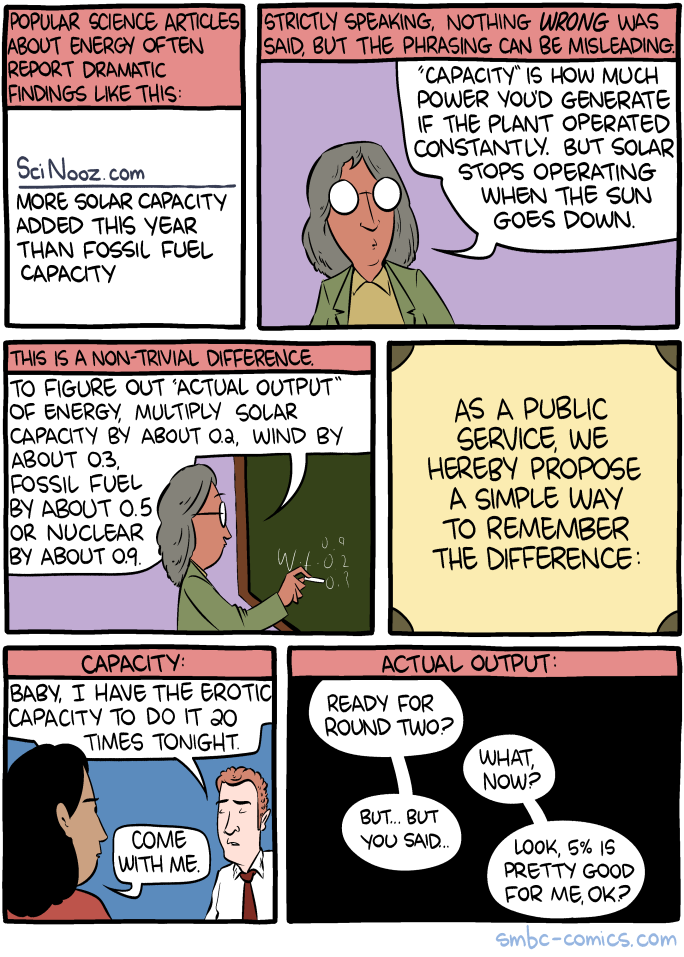
The comic addresses a common misunderstanding in energy reporting. Popular science articles frequently report that a country or region has more solar capacity than fossil fuel capacity, and this is presented as dramatic progress. However, as the comic explains, "capacity" refers to how much power you get if the plant operated completely -- but solar panels do not run at full capacity all the time (due to nighttime, clouds, etc.), so the actual output is much lower than the stated capacity. The comic notes that actual output of energy from solar is still a small fraction of what fossil fuels produce.
To help the public remember this distinction between "capacity" and "actual output," the comic proposes a mnemonic: one character says "I have sex with all my capacity," and when asked "Ready for action tonight?" responds "But... my actual output is pretty good too... like 5 to 15%." The joke is that the character boasts about theoretical maximum performance while admitting the real-world results are far more modest -- a perfect analogy for solar capacity vs. actual energy output.
The Humor
The humor comes from mapping a dry, technical energy policy distinction onto a deeply personal and embarrassing analogy about sexual performance. The idea that someone would boast about their theoretical sexual "capacity" while admitting their "actual output" is only 5-15% is both funny and memorable. It effectively illustrates why headlines about solar capacity surpassing fossil fuels can be misleading -- the theoretical maximum and the real-world performance are very different things. The comic manages to be educational while also being self-deprecating and absurd.
References
The comic references real debates in energy policy about the difference between "nameplate capacity" (the maximum rated output of a power plant) and "capacity factor" (the ratio of actual output to maximum possible output over time). Solar panels typically have capacity factors of 15-25%, meaning they produce far less energy than their rated maximum, primarily because the sun does not shine 24 hours a day and weather affects output. This distinction is important in energy journalism, where headlines about capacity can be misleading if readers assume capacity equals actual production.