Causal
Explanation
The Joke
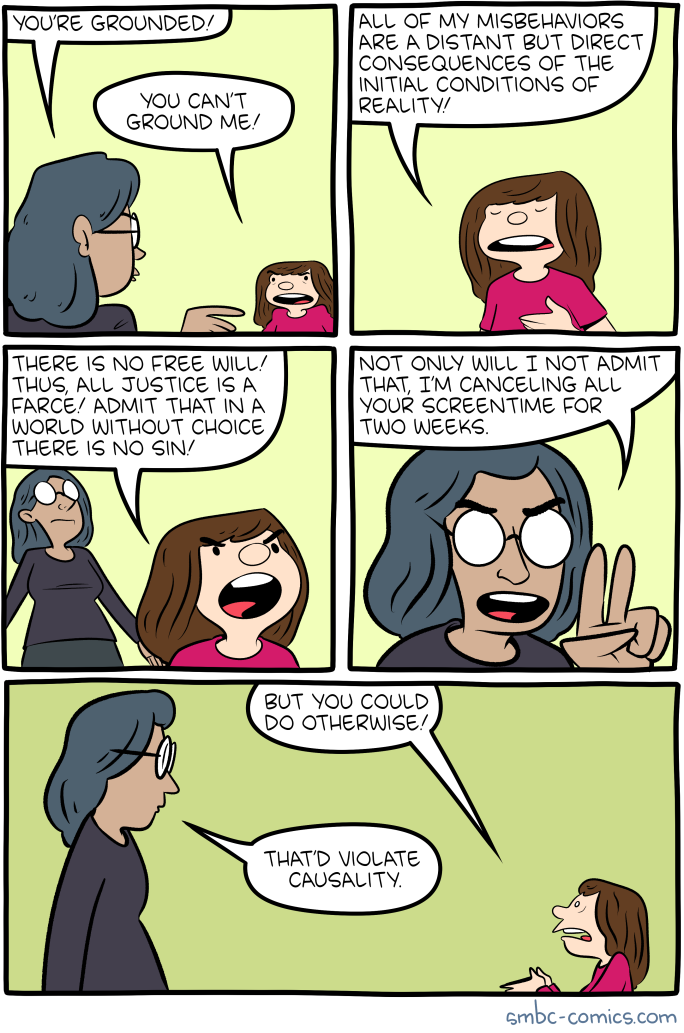
A parent tells their teenager "You're grounded!" The teenager retorts "You can't ground me!" and then launches into a philosophical argument: "All of my misbehavior is a direct but deeply complex consequence of the initial conditions of the Big Bang." In other words, determinism means that everything they did was inevitable from the moment the universe began, so they cannot be held responsible.
The parent counters: "There is no free will, there is no 'I' to punish, and there is also no reason to avoid arbitrary punishment, there is just causation." The teenager tries to argue "But you could do otherwise!" and the parent delivers the punchline: "That'd violate causality." The parent has turned the teenager's own deterministic argument against them -- if free will does not exist, then the parent's decision to ground the teenager is equally predetermined and unavoidable.
The Humor
The comic is a brilliant philosophical judo move. The teenager tries to use hard determinism to escape punishment, but the parent uses the exact same logic to justify the punishment. If no one has free will, then the parent grounding the child is just as predetermined as the child's misbehavior. The teenager is hoisted by their own philosophical petard. The humor also comes from the absurdity of a parent-teenager grounding argument being conducted in the language of physics and philosophy. The punchline "That'd violate causality" is delivered with the same finality a parent would normally say "Because I said so."
References
The comic deals with the philosophical problem of determinism and free will. Hard determinism holds that every event, including human decisions, is the inevitable result of prior causes stretching back to the initial conditions of the universe (the Big Bang). This raises the problem of moral responsibility: if no one could have done otherwise, can anyone be held accountable? The comic cleverly shows that determinism cuts both ways -- it eliminates both blame and the obligation to be lenient. This connects to philosophical debates going back to Spinoza, Laplace, and more recently, thinkers like Sam Harris and Daniel Dennett.