chaos
Explanation
The Joke
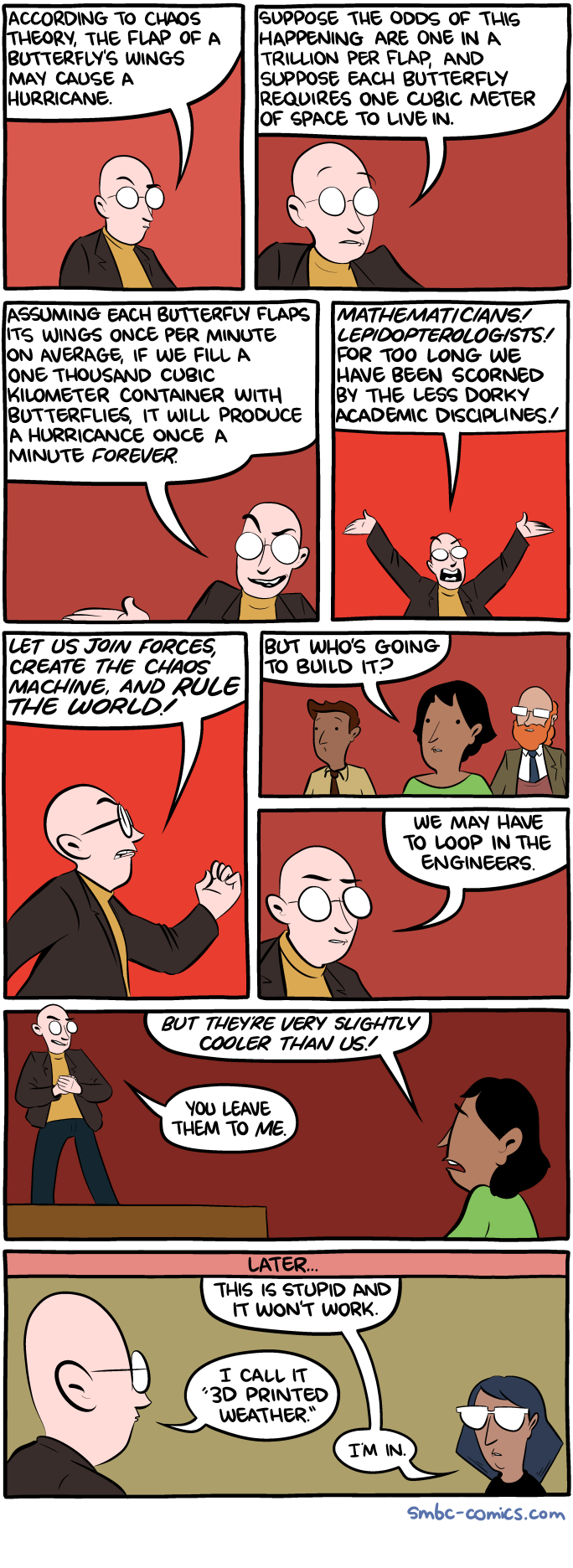
A villainous-looking character proposes weaponizing chaos theory. He notes that according to chaos theory, the flap of a butterfly's wings may cause a hurricane, and calculates that if each butterfly flaps its wings once per minute on average, and you fill a one-cubic-kilometer container with butterflies, it will produce a hurricane once a minute forever. He proposes that they join forces to create this "chaos machine" and rule the world.
The problem arises when they need engineers to build the giant butterfly container. They note that mathematicians and cosmologists have been working too long in the ivory tower and need to recruit engineers, but engineers are "very slightly cooler than us." The final panel shows them pitching the idea to an engineer who dismisses it as stupid, but then the lead villain rebrands it as "3D printed weather" and the engineer is immediately on board.
The Humor
The comic operates on multiple levels of absurdity. First, it takes the butterfly effect -- a metaphor for sensitive dependence on initial conditions in chaotic systems -- and treats it as a literal, scalable engineering principle, as if stuffing enough butterflies into a box would reliably produce hurricanes on demand. Second, it satirizes the rivalry between theoretical academics and engineers, with the punchline that engineers will reject any idea as stupid unless you rebrand it with a buzzword like "3D printed." The phrase "3D printed weather" is a perfect parody of tech-industry hype culture, where adding trendy terminology to any concept makes it sound innovative.
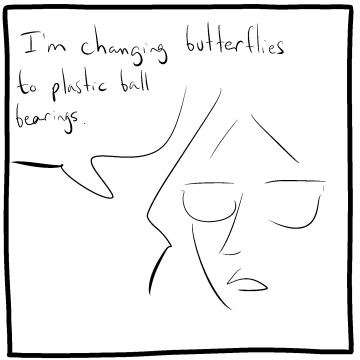
The votey shows someone saying "I'm changing butterflies to plastic ball bearings," further emphasizing the absurdity of treating the butterfly effect as a literal engineering specification rather than a metaphor.
References
Chaos theory is a branch of mathematics dealing with systems that are highly sensitive to initial conditions. The "butterfly effect" was coined by meteorologist Edward Lorenz, who noted that small perturbations in atmospheric models could lead to vastly different outcomes. The original metaphor was never meant to suggest that actual butterflies cause actual hurricanes, but rather that tiny measurement differences can cascade into dramatically different predictions. The joke about "3D printing" satirizes the mid-2010s tech hype cycle, where 3D printing was attached as a buzzword to nearly everything.