chesterton
Explanation
The Joke
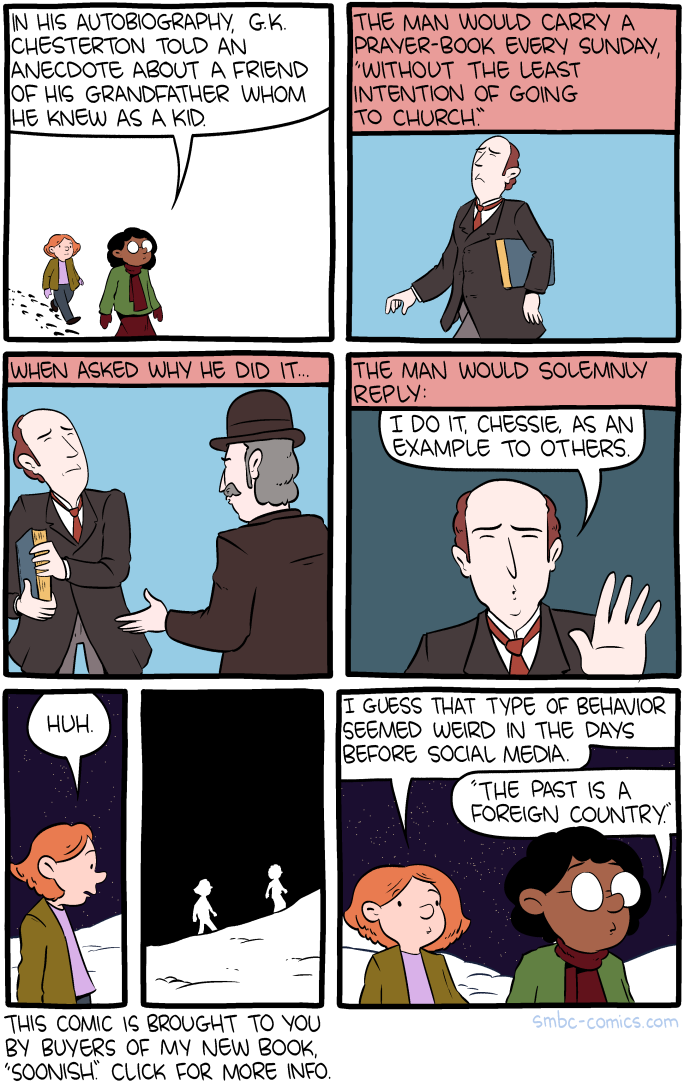
The comic recounts an anecdote from G.K. Chesterton's autobiography about a friend of his grandfather whom he knew as a child. This man would carry a prayer-book every Sunday "without the least intention of going to church." When asked why he did it, the man would solemnly reply, "I do it, Chessie, as an example to others." The joke is that the man performatively carried a prayer-book to project an image of piety without actually being pious — he wanted to set a good example he himself had no intention of following.
In the modern-day panels below, two people discuss this anecdote. One says "Huh" and then observes, "I guess that type of behavior seemed weird in the days before social media." The other quotes the famous line, "The past is a foreign country." The implication is that performative virtue — projecting an image of goodness without actually practicing it — was considered strange and eccentric in Chesterton's era, but is now the absolute norm thanks to social media, where people constantly signal virtues they do not practice.
The Humor
The comedy comes from the sharp observation that what was once considered charmingly eccentric behavior — performing piety without genuine belief — has become the defining feature of modern online culture. Social media is full of people projecting values, beliefs, and lifestyles they do not actually live. Chesterton's grandfather's friend would fit right in on Instagram or Twitter, where virtue signaling is so commonplace it would not even register as unusual. The quote "The past is a foreign country" adds a wry layer, suggesting that the real cultural shift is not that people have gotten more hypocritical, but that hypocrisy used to be noteworthy rather than the default mode of self-presentation.
References
G.K. Chesterton (1874-1936) was an English writer, philosopher, and literary critic, best known for his Father Brown mystery stories and his Christian apologetics. His autobiography, referenced in the comic, was published in 1936. The anecdote about the man with the prayer-book is a real story from the book.
"The past is a foreign country" is the famous opening line of L.P. Hartley's 1953 novel The Go-Between: "The past is a foreign country: they do things differently there." It has become a widely used aphorism about the difficulty of understanding historical periods through a modern lens.
The comic also includes a note at the bottom that it was "brought to you by buyers of my new book, Soonish," referring to Soonish: Ten Emerging Technologies That'll Improve and/or Ruin Everything, a 2017 book by Zach Weinersmith and Kelly Weinersmith about emerging technologies.