christ

Explanation
The Joke
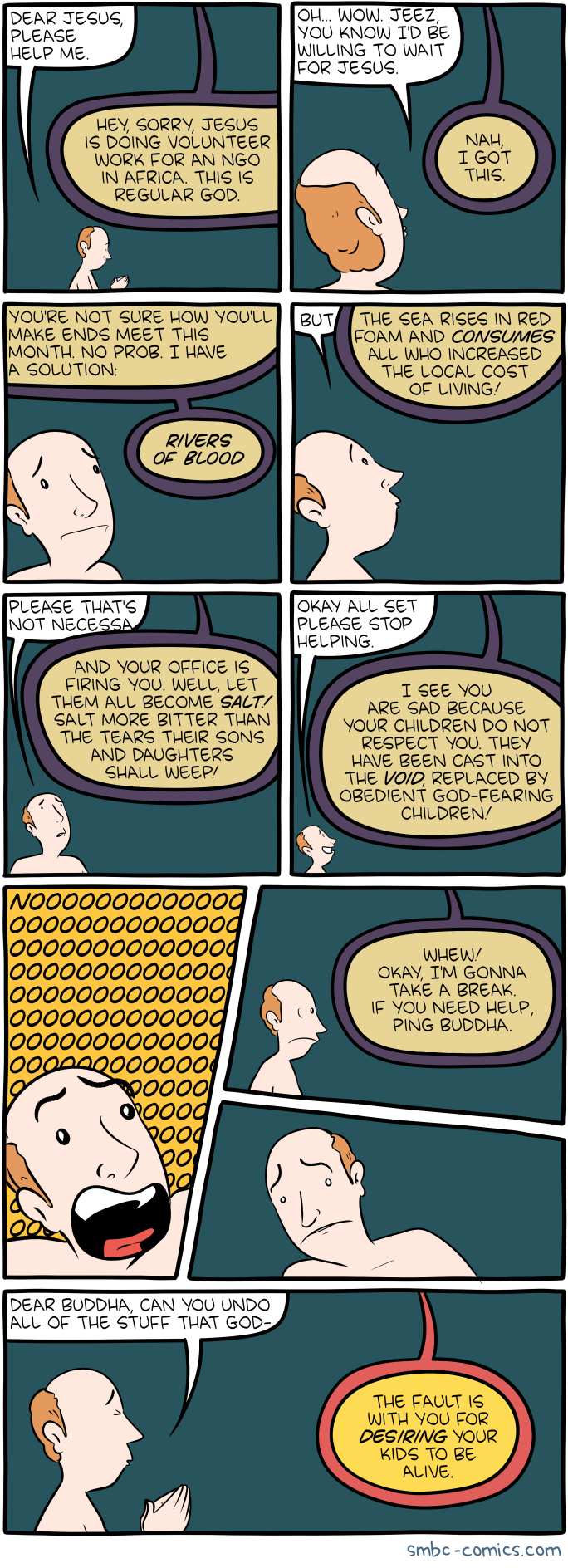
A person prays to Jesus for help, but is told that Jesus is busy doing volunteer work for an NGO in Africa, so they'll be dealing with "regular God" instead. What follows is a series of increasingly disastrous divine interventions from Old Testament-style God. When the person can't make ends meet, God suggests "rivers of blood" as a solution. When told that's not necessary, God offers to send plagues and darkness to their office. When the person's children don't respect them, God replaces the kids with "obedient God-fearing children" made from the pond. Each escalation horrifies the person more than the last.
Finally, the person gives up and says they'll find Buddha instead, only for God to get in a parting shot: "The fault is with you for desiring your son to be alive" -- a savage (and deliberately mangled) invocation of Buddhist philosophy about attachment and suffering.
The Humor
The comic plays on the contrast between the gentle, compassionate image of Jesus in popular Christianity (here depicted as a kind social worker) and the wrathful, plague-sending, river-of-blood God of the Old Testament. The joke is that without Jesus acting as a moderating influence, "regular God" defaults to Old Testament behavior -- solving every problem with apocalyptic overkill. The final panel adds an extra layer by having God preemptively undermine the person's escape to Buddhism by weaponizing the Buddhist concept of non-attachment in the cruelest possible way, suggesting that God is not just unhelpful but actively malicious regardless of which religious framework you try to use.
References
The comic references the theological distinction between the New Testament portrayal of God through Jesus (emphasizing love, forgiveness, and service) and the Old Testament depictions of God (plagues of Egypt, rivers of blood, destruction of cities). The rivers of blood and plagues allude to the ten plagues of Exodus. The final panel's quip about desire and attachment parodies the Buddhist concept of dukkha (suffering) and the Second Noble Truth, which holds that suffering arises from craving and attachment.