cleaning-algorithms
Explanation
The Joke
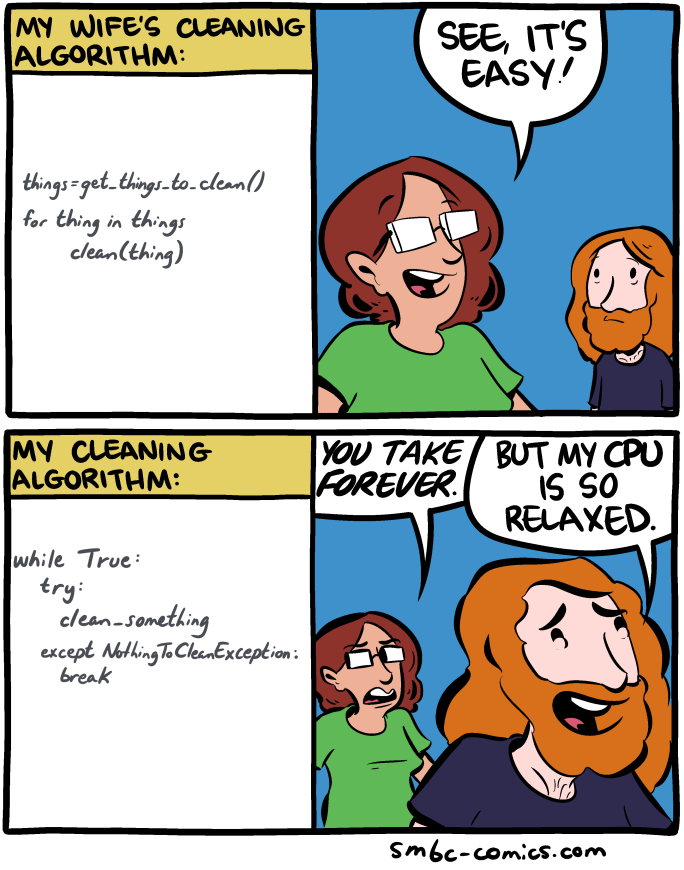
The comic compares a husband and wife's approaches to cleaning, expressed as programming pseudocode.
The wife's cleaning algorithm is efficient and straightforward:
things = get_things_to_clean()
for thing in things:
    clean(thing)
She says, "See, it's easy!" This is a simple loop that gets all the things that need cleaning and cleans them one by one.
The husband's cleaning algorithm is:
while True:
    try:
        clean_something
    except NothingToCleanException:
        break
His wife says, "You take forever," and he responds, "But my CPU is so relaxed." His approach is an infinite loop that tries to clean something, and only stops when there is nothing left to clean (catching a NothingToCleanException). This is a much less efficient approach -- instead of knowing what needs to be cleaned upfront, he wanders around aimlessly trying to clean things until he runs out.
The Humor
The comedy works by translating a common domestic complaint (one partner cleans efficiently while the other dawdles) into programming terminology. The wife's approach is a deterministic, planned algorithm -- she surveys the work, makes a list, and executes. The husband's approach is a lazy, exception-driven pattern -- he stumbles around attempting to clean random things without any plan, relying on trial and error. His defense that his "CPU is so relaxed" is a programming joke: his algorithm uses less computational planning overhead, even though it takes much longer in practice. The comic resonates with both programmers (who recognize the anti-pattern of exception-driven control flow) and non-programmers (who recognize the universal dynamic of one partner being organized while the other procrastinates).
References
- The pseudocode is written in Python syntax, a popular programming language.
- Exception-driven control flow (using try/except to control program logic rather than proper conditionals) is generally considered a code anti-pattern, as it is less readable and often less efficient.
- The husband's algorithm resembles a busy-wait or polling pattern, which is typically discouraged in software engineering.