coffee-2
Explanation
The Joke
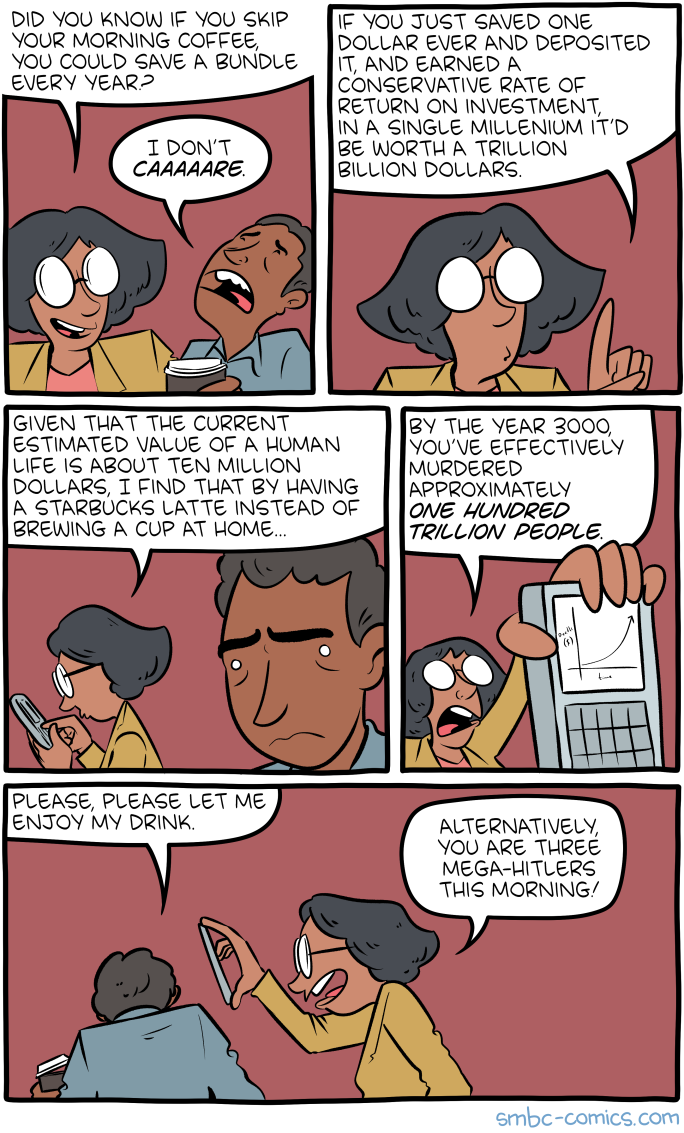
The comic opens with someone asking, "Did you know if you gave up your morning coffee, you could save a bundle every year?" The listener responds with exaggerated indifference: "I don't caaaaare." The first person then escalates dramatically: if you saved one coffee's cost per day and deposited it at a reasonable rate of compound interest, in a single millennium you would have 80 billion dollars.
The second speaker then applies the same logic in reverse: given that a human life is about ten million coffees long, you could save ten million lives just by having everyone give up drinking a cup of coffee. The first speaker begs, "Please, please let me destroy my data." The second person refuses, noting that by the year 3000, this math means the coffee-quitter could have "already murdered one mega-Hitler's worth of trillion people" -- implying that by NOT saving, coffee drinkers are responsible for hypothetical future deaths on a scale that dwarfs history's worst atrocities.
The Humor
The comic satirizes the common personal-finance advice about small daily savings (the "latte factor") by taking compound interest calculations to their absurd logical extreme. The joke escalates from a reasonable tip about saving money to millennium-scale financial projections, then to the utilitarian argument that not saving money is morally equivalent to mass murder on a cosmic scale. The phrase "mega-Hitlers" as a unit of measurement for hypothetical deaths caused by coffee consumption is the peak of the absurdity. The comic mocks how any small daily expenditure can be made to seem catastrophically irresponsible if you extend the time horizon far enough and apply enough utilitarian moral weight.
References
The "latte factor" is a personal finance concept popularized by David Bach in his book "The Automatic Millionaire" (2004), which argues that small daily expenses like coffee add up to significant sums over time. The comic also parodies certain strands of effective altruism and utilitarian ethics that attempt to quantify the moral weight of personal spending decisions.