Command
Explanation
The Joke
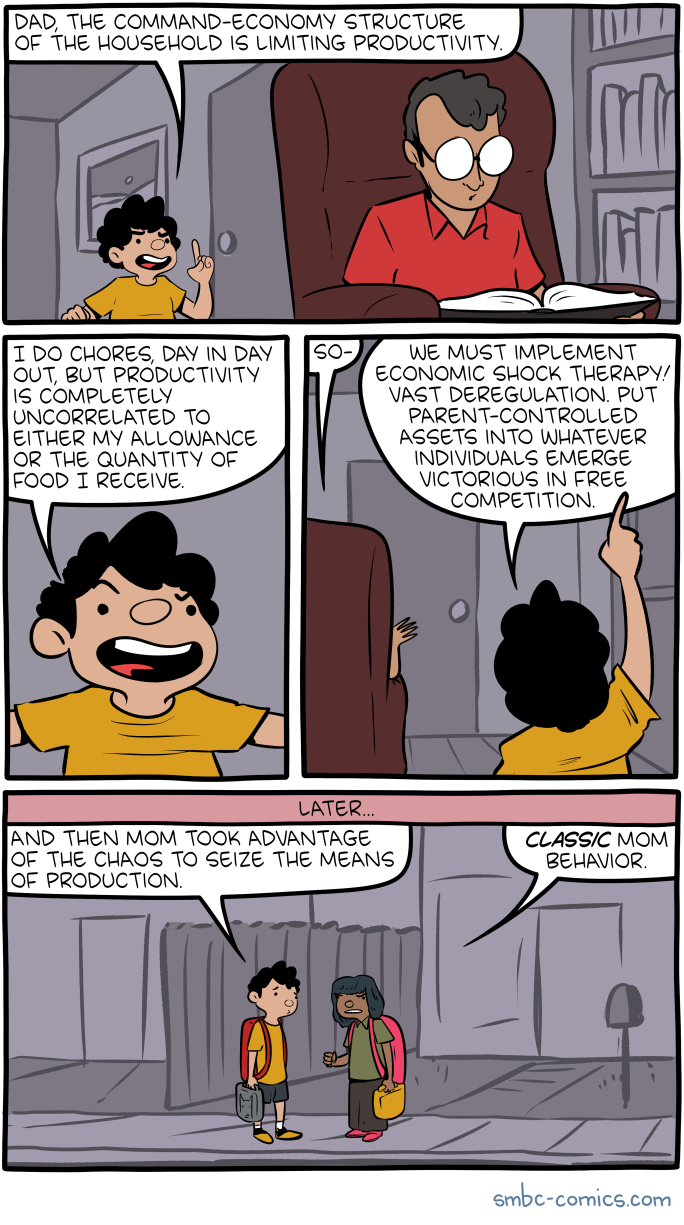
A father figure, drawn in a serious authoritative pose, declares that the "command economy structure of the household is limiting productivity." He proposes implementing various economic reforms: cognitive behavioral therapy, parent-controlled allowance systems tied to individual energy and resource outputs. The child responds by doing chores day in and day out despite their efforts being unrelated to either their allowance or the quantity of food they receive.
The punchline comes in the final panels: the child, having been exposed to economic theory through their parent's rhetoric, "took advantage of the chaos to seize the means of production" -- a reference to communist revolution. The caption labels this as "classic mom behavior," implying the mother orchestrated the whole thing.
The Humor
The comedy works on multiple levels. First, there is the absurdity of applying formal economic theory to household chore distribution -- treating a family like a nation-state with productivity concerns. Second, there is the irony that the father's attempt to introduce free-market incentive structures into the household inadvertently teaches the child enough economic theory to stage a Marxist revolution. The label "classic mom behavior" at the end implies this was all a deliberate manipulation by the mother, adding a layer of domestic scheming to the political satire.
The comic also satirizes how economic ideologies play out in practice: the father's free-market reforms backfire spectacularly, resulting in the very communist uprising that free-market advocates fear most.
References
The comic references command economies (centrally planned economic systems like those of the Soviet Union), free-market capitalism, cognitive behavioral therapy, and most prominently Karl Marx's concept of "seizing the means of production" from "The Communist Manifesto." The household serves as a microcosm for the broader ideological conflict between capitalism and communism.