commodities

Explanation
The Joke
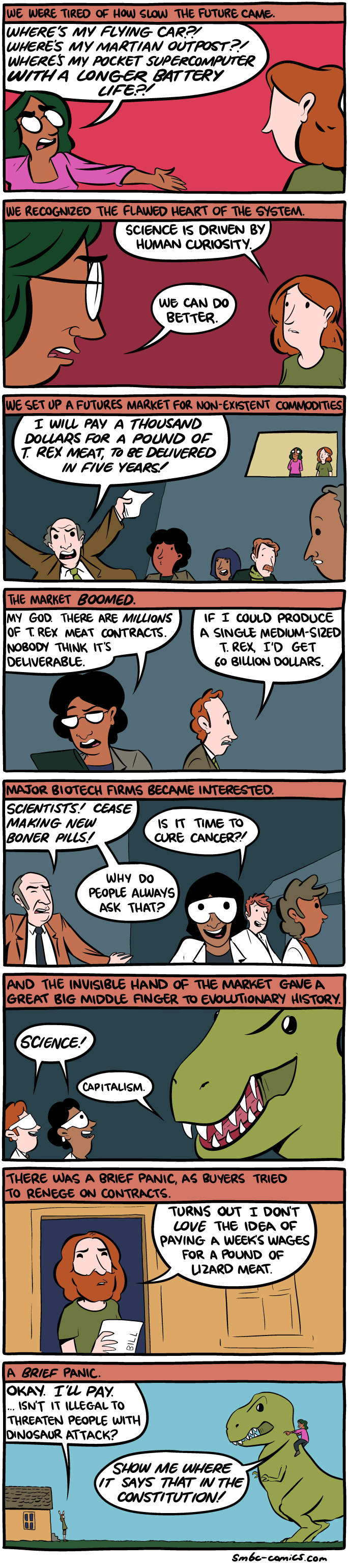
The comic opens with someone demanding to know where all the futuristic technologies are: flying cars, Martian outposts, pocket supercomputers with London battery life. Another character responds that the pursuit of commodities is the outcome of science being driven by human curiosity, and that no one can force it to be "better." A third character then offers a market-based solution: he will pay a thousand dollars for a jar of Martian soil, and argues that if key discoveries are treated as commodities, they must be deliverable at a fair price. Others then brainstorm what market mechanisms could incentivize: one suggests if they could produce a beef meat substitute from plants, they'd have a trillion-dollar industry; another proposes a single uranium container to replace a billion dollars in coal. They ask a character if this is a good time for making new markets. The response escalates through various constituencies — purple-haired people saying "science!", a dinosaur saying "Christmas!", and a reference to whether a constitutional amendment would be needed. The comic depicts an increasingly chaotic brainstorming session about using market incentives for scientific progress.
The Humor
The humor comes from the collision between idealistic views of science (driven purely by curiosity) and the pragmatic reality that market incentives could potentially drive innovation more effectively. The comic satirizes multiple perspectives: the naive techno-optimist who just wants flying cars, the purist who insists science can't be directed, and the economist who thinks everything can be solved with the right price signal. The escalating chaos of the brainstorming session — culminating in a dinosaur and constitutional law — parodies how discussions about science policy quickly spiral out of control when everyone has a different agenda. The joke is also self-aware about the tension in Weinersmith's own worldview, as SMBC frequently explores both the beauty of pure science and the frustration that market forces don't always align with scientific progress.