compatibilism
.png)
Explanation
The Joke
The comic is titled "Compatibilism: A Parable" and presents two parallel scenes that draw an analogy between a misleading promise and the philosophical position of compatibilism.
In Scene 1, a parent excitedly offers to show a child a real, live dinosaur. The child is thrilled and they rush off together. But the "dinosaur" turns out to be a pigeon -- because pigeons are among the closest living descendants of dinosaurs. The child is furious: "You KNEW what I would think when you said there was a dinosaur, and you still did this!" The parent responds, "I'm sorry, I thought you were intellectual."
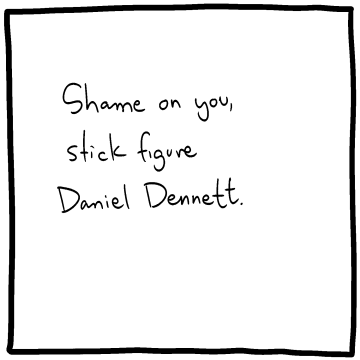
In Scene 2, a philosopher offers to show that free will is compatible with a deterministic universe. The excited listener agrees to discourse. The philosopher then explains that the common notion of free will is "stupid to the point of vacuity," and that by redefining free will, it can be made compatible with determinism. The listener is furious with the same complaint: "You KNEW what I would think when you said compatibilism is possible, and you still did this!" The philosopher delivers the punchline: "I HAD NO CHOICE" -- a determinism joke, since in a deterministic universe, the philosopher literally could not have done otherwise.
The Humor
The humor works through the precise structural parallel between the two scenes. Just as calling a pigeon a "dinosaur" is technically accurate but deeply misleading, compatibilism "solves" the free will problem by redefining free will in a way that many people find unsatisfying -- you get "free will," but not the kind you were hoping for. The child/listener feels bait-and-switched in both cases.
The final punchline -- "I had no choice" -- is a perfect self-referential joke. If determinism is true and the philosopher is a compatibilist, then they literally had no choice but to mislead the listener, which both undercuts the listener's complaint and reinforces the very point being made about determinism. It also mirrors the first scene's dismissive "I thought you were intellectual" but in a far more clever way.
References
Compatibilism is a position in the philosophy of free will that holds that free will and determinism are not mutually exclusive. Compatibilists (such as Daniel Dennett and Harry Frankfurt) argue that "free will" should be understood not as the ability to have done otherwise in an absolute metaphysical sense, but rather as acting according to one's own desires without external coercion. Critics (often called "hard incompatibilists" or "free will skeptics") argue this amounts to redefining free will so drastically that it no longer means what most people intuitively take it to mean -- which is precisely the complaint the comic dramatizes. The pigeon-dinosaur analogy is scientifically accurate: birds are theropod dinosaurs, and pigeons are among the most commonly encountered living dinosaurs.