computer

Explanation
The Joke
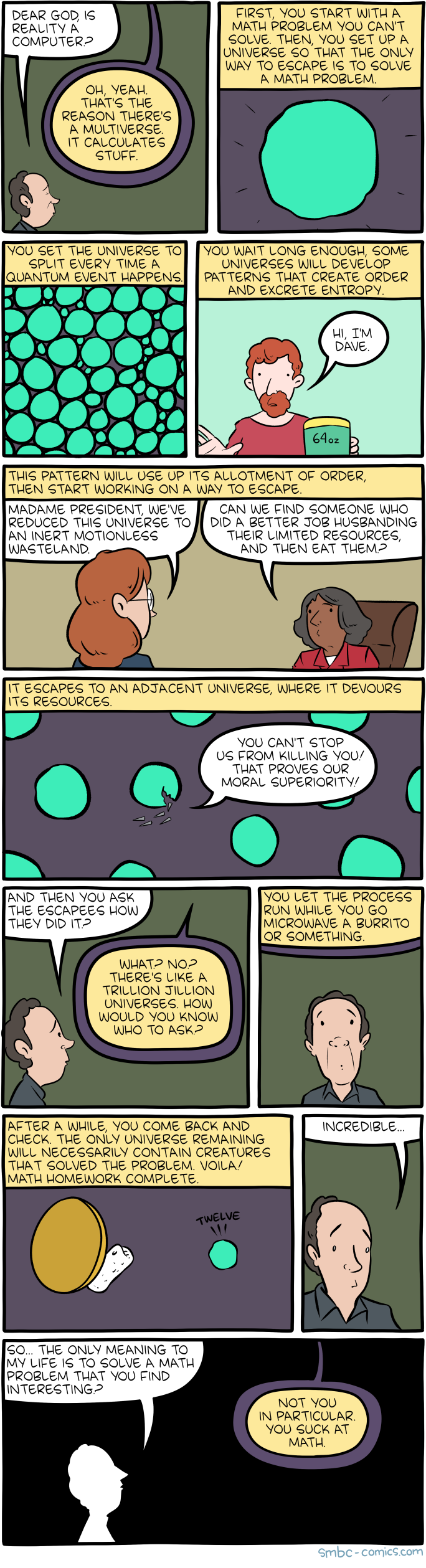
The comic presents a long theological and philosophical conversation between a person and God about the nature of the universe. The person asks God: "Dear God, is reality a computer simulation?" God responds affirmatively and explains the situation: the universe started with a math problem, then God used computing power to search for patterns that create order and complexity. God built a "little universe" to work on the problem, and eventually the simulated universe produced sentient beings who started asking these kinds of questions.
The conversation takes a dark turn when the person asks if God could find someone who would do a better job than "harassing his simulants." God defends the work, then reveals that the simulated universe will inevitably devour itself. When the person asks about moral superiority, God deflects. Eventually God reveals the truly disturbing twist: the only interesting thing God has discovered from the simulation is that "you" (the questioner) are "in particular very boring."
The Humor
The comic takes the popular "simulation hypothesis" -- the idea that our reality might be a computer simulation -- and plays it out to its most deflating conclusion. Instead of our simulated existence serving some grand cosmic purpose, it turns out we are just a byproduct of God trying to solve a math problem, and the simulation is not even going particularly well. The final punchline undercuts any remaining sense of cosmic significance: not only is humanity an accidental side effect of a computation, but the individual asking the deep philosophical questions is singled out as especially boring. The humor builds through a series of escalating disappointments -- each answer to the "big questions" is less satisfying and more banal than the last. It is a classic SMBC structure of taking a philosophical premise seriously only to arrive at the most anticlimactic possible conclusion.
References
The simulation hypothesis was most famously articulated by philosopher Nick Bostrom in his 2003 paper "Are You Living in a Computer Simulation?" The idea has been widely discussed in popular culture and by public figures such as Elon Musk. The comic also touches on themes from computational cosmology and the fine-tuning argument in theology.