Conation

Explanation
The Joke
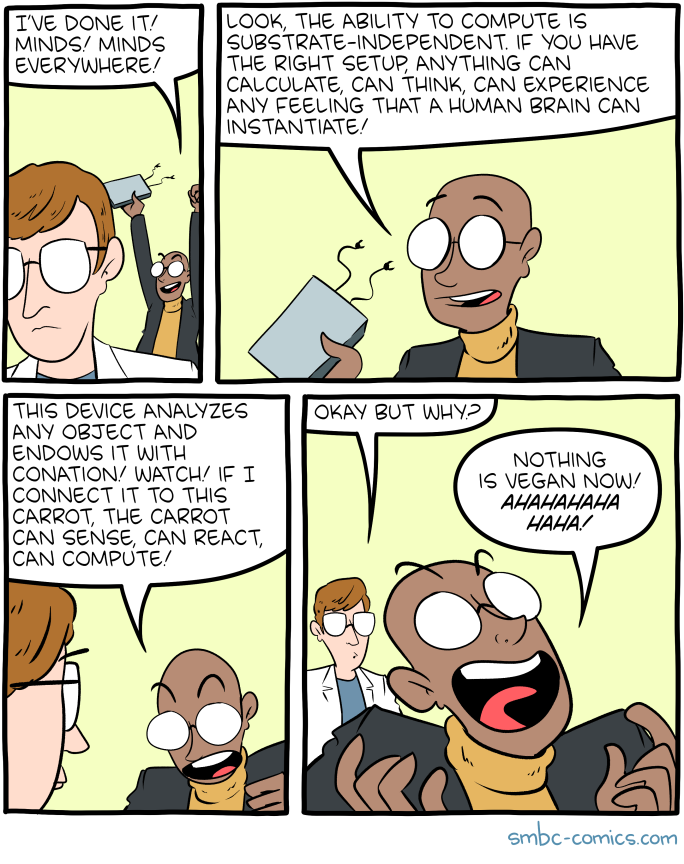
A person proudly presents a device that can "compute things about minds everywhere" -- it has the ability to compute subjective experience, so if you give it any brain configuration it can calculate everything that brain can experience, including every thought, feeling, and quale that a human brain can instantiate. The inventor demonstrates this incredible-sounding technology by showing it can analyze emotions, cognitive states, and even "conation" (the mental faculty of purpose, desire, and will to act).
However, the punchline comes when the other character says "Okay, but wait" and the inventor deflects with "Nothing is useful now! Come back in 50 years!" This reveals the classic gap between a theoretically impressive scientific breakthrough and any practical application. The device can supposedly replicate all of conscious experience computationally, but there is absolutely nothing useful to do with that capability right now.
The Humor
The comic satirizes a common pattern in cutting-edge research, particularly in fields like neuroscience and consciousness studies, where scientists make grandiose claims about understanding the mind but struggle to articulate any near-term practical benefit. The inventor's defensive retreat to "come back in 50 years" is a familiar refrain from researchers who want credit for a breakthrough without having to justify its immediate utility. The title "Conation" -- an obscure psychological term for the will to act -- is itself a meta-joke: the device understands conation theoretically but its creator lacks the conation to make it useful.
References
"Conation" is one of three traditionally recognized faculties of the mind in psychology, alongside cognition (thinking) and affect (feeling). It refers to the drive or will that motivates action, and is far less commonly discussed than the other two, making it a perfectly obscure term for SMBC's brand of academic humor.