confession

Explanation
The Joke
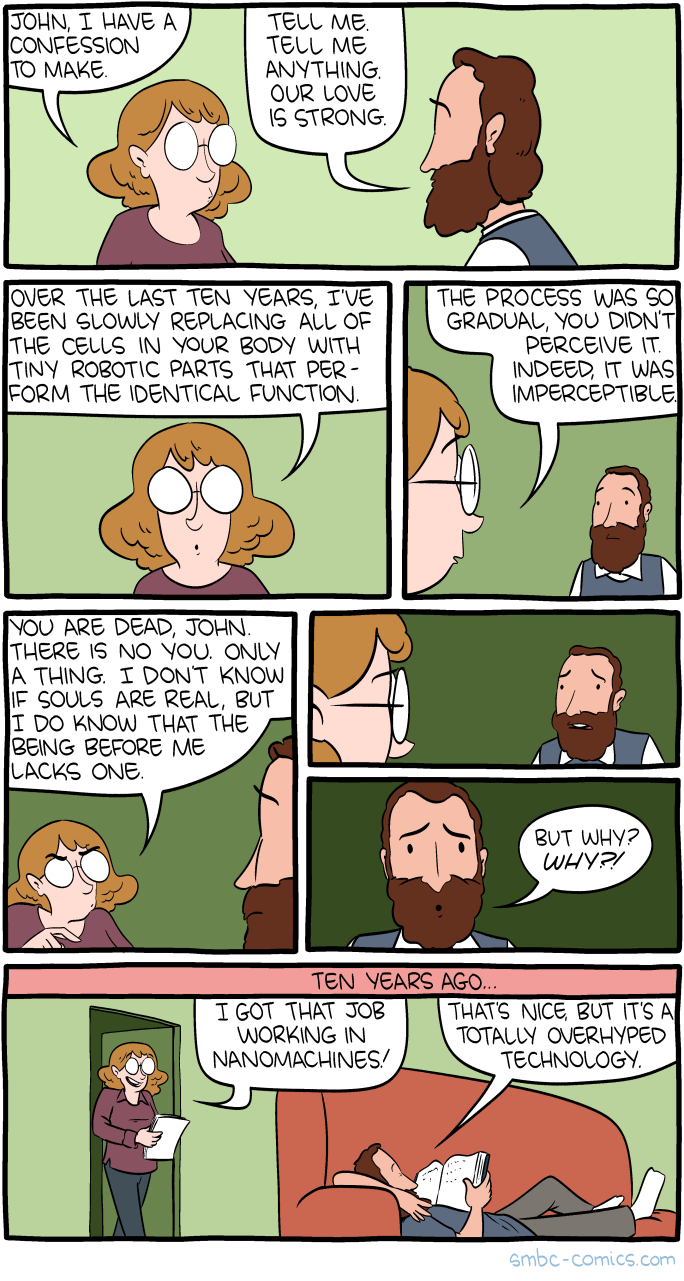
The comic shows a couple where the man says he has a confession to make. His partner tells him to go ahead, reassuring him that their love is strong. He then reveals: "Over the last ten years, I've been slowly replacing all the cells in your body with tiny robotic parts that perform the identical function." His partner is outraged, but he argues that the replacement was imperceptible -- suggesting it should not matter if the result is functionally identical.
The argument then shifts: he claims that if souls are real, there is no way she only lost hers at the precise moment the last organic cell was replaced, and that the process must have been gradual. His partner protests "But why?!" and in the final panel we see he is presenting this scenario at what appears to be a philosophy conference or talk, framing it as "not a great first date, but it's a totally overlooked thought experiment." He works in nanotechnology.
The Humor
The comic is a riff on the Ship of Theseus paradox -- if you gradually replace every part of something, is it still the same thing? Here, the thought experiment is applied to a romantic partner's body, which makes the abstract philosophical puzzle viscerally horrifying. The reveal that this actually happened (or is being proposed as if it happened) on a first date adds absurdist humor: the man is so enamored with the philosophical implications that he is blind to the massive ethical violation of secretly replacing someone's cells. The final panel recontextualizes the whole scenario as an academic presentation, suggesting the man views "nonconsensually converting your date into a cyborg" primarily as an interesting philosophical puzzle rather than a crime.
References
- The Ship of Theseus is a classical philosophical paradox asking whether an object that has had all of its components replaced remains fundamentally the same object. It dates back to Plutarch's writings about the legendary ship of the Greek hero Theseus.
- The gradual cell replacement also echoes the biological fact that human bodies replace most of their cells over roughly 7-10 years, raising the question of personal identity over time.