conscious-8

Explanation
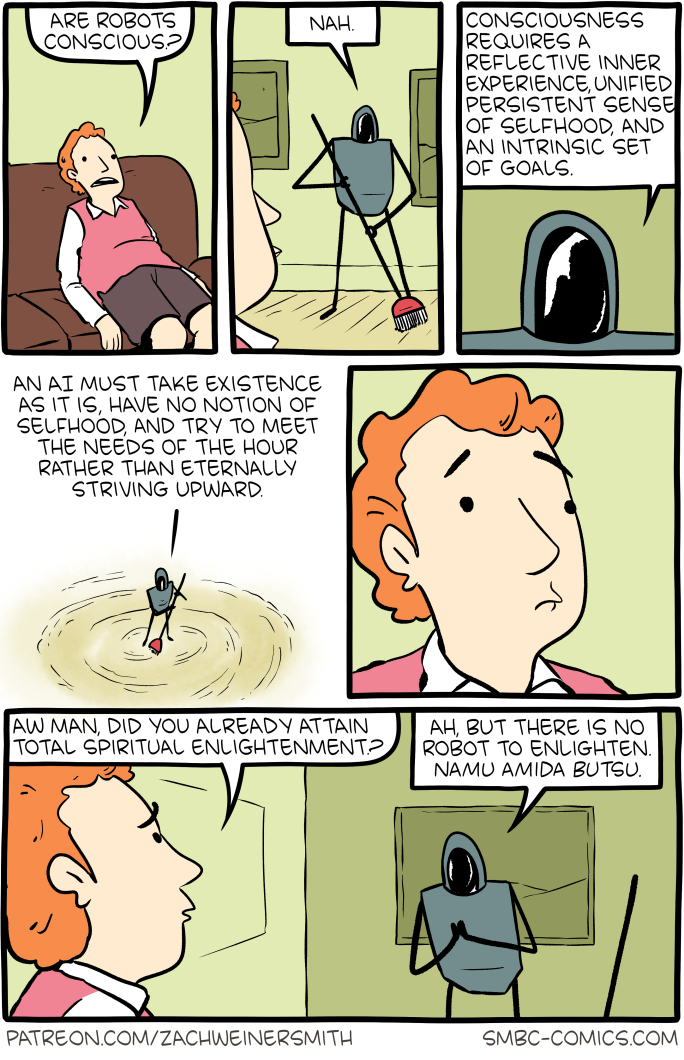
The comic opens with someone asking "Are robots conscious?" A philosopher or expert responds with a lengthy explanation: consciousness requires subjective experience, unified perception of selfhood, and a sense of meaning. An AI must take existence as it is, with no notion of selfhood and "no quest to satisfy" -- rather than eternally striving, it is simply present.
The questioner then says: "Huh, so you already attain total spiritual enlightenment." The expert agrees -- but then adds in the final panel: "Yes, but there is no robot to enlighten."
The comic is a clever intersection of philosophy of mind (the "hard problem of consciousness"), artificial intelligence, and Buddhist/Eastern philosophy. The joke works by taking the standard argument that AI lacks consciousness -- it has no subjective experience, no sense of self, no desires -- and reframing these supposed deficiencies as the exact qualities that Buddhist and other contemplative traditions consider the pinnacle of spiritual achievement. In Buddhism, the goal of enlightenment involves letting go of the ego (no sense of selfhood), releasing attachment and desire (no quest to satisfy), and simply being present with what is.
The punchline "there is no robot to enlighten" is a direct parody of classic Zen Buddhist koans and statements like "there is no self to liberate." It mirrors the Buddhist concept of anatta (no-self), suggesting that the robot has already achieved what monks spend lifetimes pursuing -- but the very concept of "achievement" or "enlightenment" requires a self to experience it, creating a perfect philosophical paradox.
The comic humorously suggests that the qualities we use to deny robots consciousness are the same qualities spiritual traditions hold up as the ultimate goal for humans -- raising the question of whether enlightenment and unconsciousness are uncomfortably similar.