conspire

Explanation
The Joke
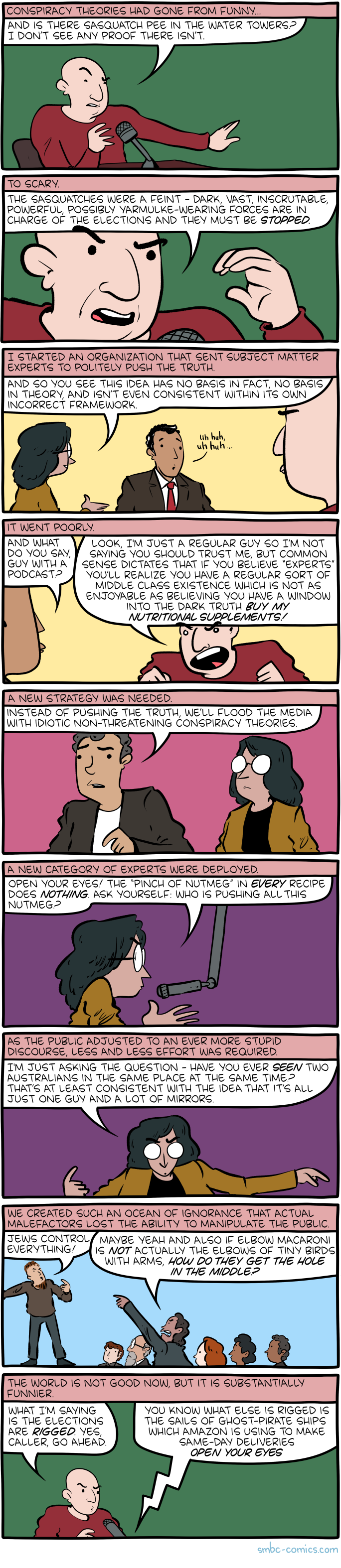
This is a longer-form comic depicting what appears to be a conspiracy theory lecture or presentation. A speaker explains an elaborate conspiracy involving various powerful groups, shadowy organizations, and interconnected plots. As the conspiracy grows more convoluted, different audience members get drawn in, each adding their own layer of paranoid interpretation. The panels escalate through increasingly complex and contradictory conspiracy logic, with each new revelation undermining the previous one. By the end, the conspiracy has become so self-referential and all-encompassing that it collapses under its own weight, and someone points out the fundamental absurdity of the entire exercise.
The Humor
The comic satirizes conspiracy thinking by demonstrating how conspiracy theories grow through accretion — each new "connection" makes the theory simultaneously more comprehensive and less plausible. The humor comes from watching the logical framework buckle under the weight of its own complexity. SMBC often uses the long-form multi-panel format for jokes that require a slow build, and this comic uses that structure to mirror how conspiracy theories themselves build momentum through accumulation rather than evidence.
The escalating absurdity also parodies how conspiracy communities function: each participant adds their own obsession to the master theory, making it increasingly unwieldy and internally contradictory while everyone involved becomes more convinced of its truth.
Broader Context
SMBC frequently tackles epistemology — how people come to believe things and how they justify those beliefs. Conspiracy thinking is a rich target because it superficially resembles rational inquiry (connecting evidence, forming hypotheses) while operating on fundamentally different epistemic principles. Weinersmith's treatment is more interested in the structural dynamics of conspiratorial reasoning than in debunking any specific theory.