conversion
Explanation
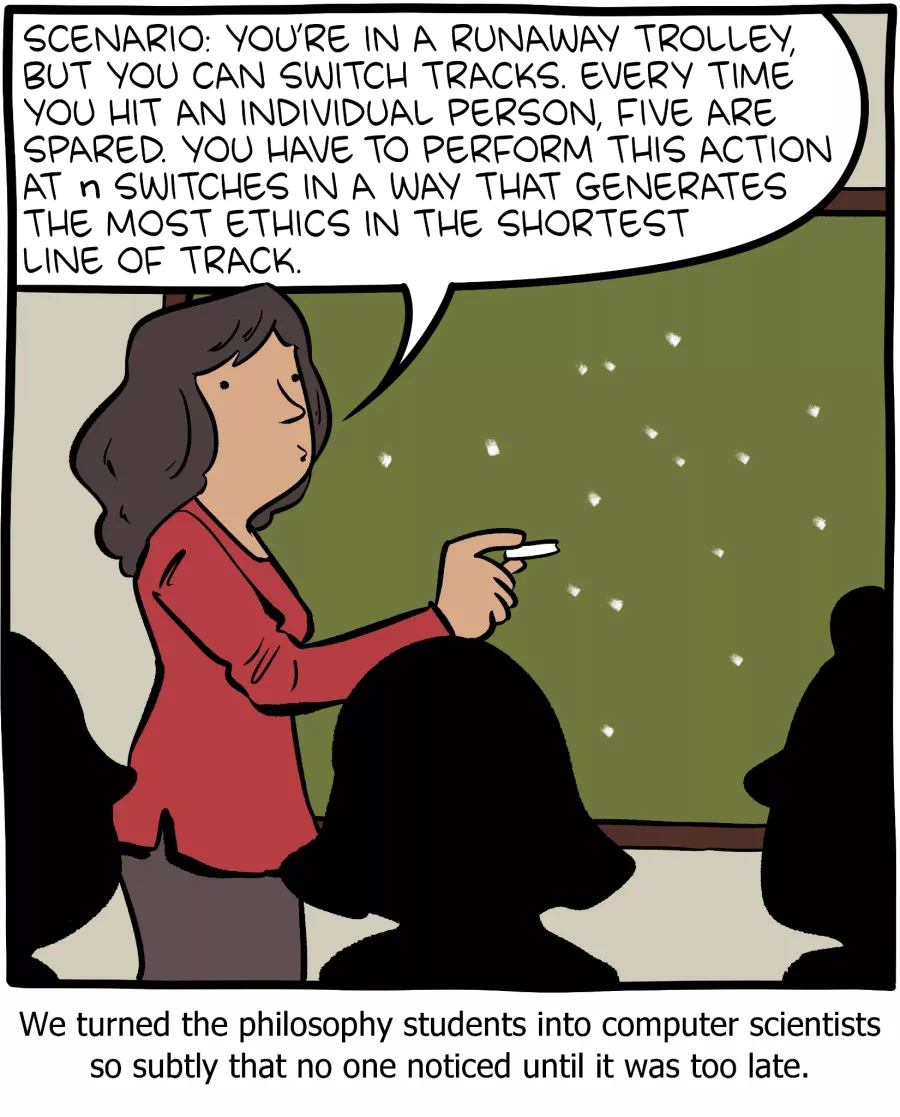
In this single-panel comic, a professor stands at a chalkboard presenting an ethics scenario to a classroom: "You're in a runaway trolley, but you can switch tracks. Every time you hit an individual person, five are spared. You have to perform this action at n switches in a way that generates the most ethics in the shortest line of track."
The caption reads: "We turned the philosophy students into computer scientists so subtly that no one noticed until it was too late."
The joke is that this is no longer a philosophy problem -- it's an optimization algorithm. The classic trolley problem in ethics asks a simple binary question about whether it is moral to sacrifice one person to save five. But by parameterizing it with "n switches" and asking students to maximize "ethics" while minimizing track length, the professor has essentially reformulated it as a graph traversal or dynamic programming problem. The students are now solving a computational optimization problem without realizing they've left the domain of moral philosophy entirely.
The title "conversion" refers both to the conversion of philosophy students into computer scientists and the conversion of an ethical dilemma into an algorithmic puzzle. The comic satirizes how optimization-minded thinking can subtly co-opt moral reasoning, and how the line between "doing ethics" and "doing computer science" can blur when you start quantifying and optimizing moral outcomes.