cosmology-2
Explanation
The Joke
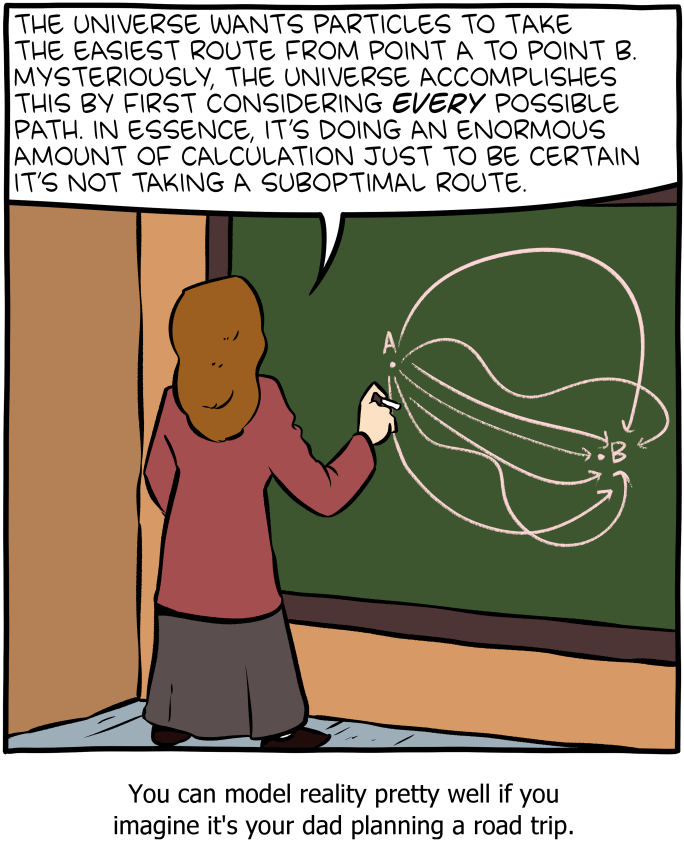
A professor is lecturing about how the universe tends to take the easiest route from point A to point B -- a reference to the principle of least action in physics. He explains that, mysteriously, the universe accomplishes this by first considering every possible path. In essence, it is doing an enormous amount of calculation just to be certain it is not taking a suboptimal route. On the blackboard behind him is a tangled, chaotic scribble representing all these possible paths being evaluated.
The caption at the bottom delivers the punchline: "You can model reality pretty well if you imagine it's your dad planning a road trip." The joke draws a parallel between the universe's seemingly over-engineered optimization process and the stereotypical father who obsessively plans every detail of a road trip, evaluating every possible route and contingency, just to save ten minutes on the drive.
The Humor
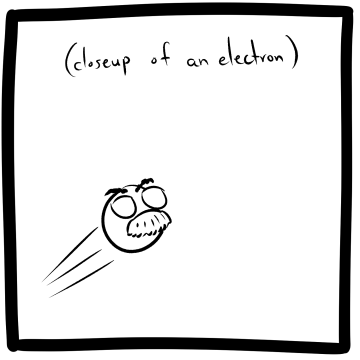
The humor comes from the unexpected but surprisingly apt analogy between quantum mechanics and dad behavior. The Feynman path integral formulation of quantum mechanics really does work by summing over all possible paths a particle could take, which is conceptually bizarre -- why would nature "consider" every option just to pick the best one? By comparing this to a dad who insists on mapping out every possible highway, back road, and rest stop before a family vacation, the comic makes an abstruse physics concept both accessible and funny. The joke also gently mocks the obsessive planning stereotype while simultaneously suggesting that dads and the fundamental laws of the universe operate on the same principle.
References
The comic references Richard Feynman's path integral formulation of quantum mechanics, introduced in the 1940s. In this framework, a particle traveling from point A to point B does not follow a single classical trajectory but instead takes "all possible paths" simultaneously, with the probability amplitude for each path contributing to the final result. The classical path emerges because nearby paths constructively interfere while wildly different paths cancel out. This is closely related to the principle of least action in classical mechanics.