cow
Explanation
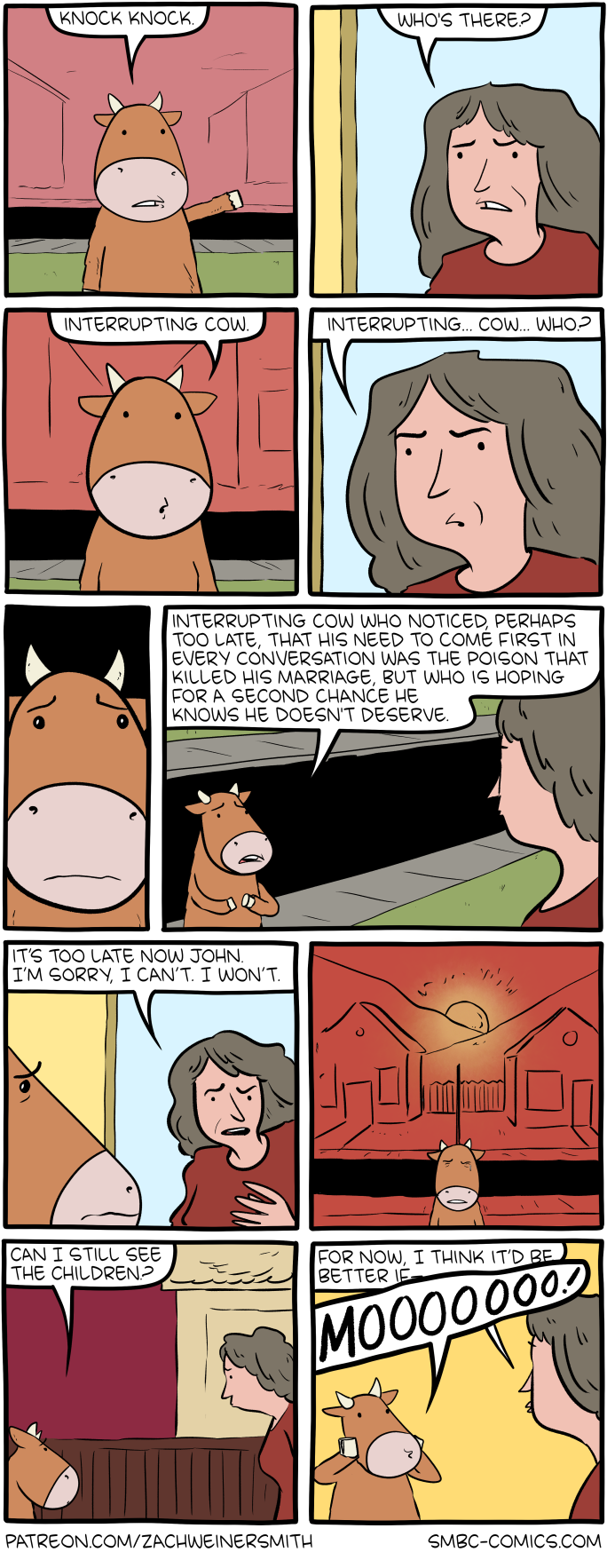
This comic is an extended riff on the classic "interrupting cow" knock-knock joke, transforming it from a simple children's joke into an emotional drama.
The comic begins with the standard setup: "Knock knock." "Who's there?" "Interrupting cow." "Interrupting cow wh--" "MOO!" This is one of the most well-known knock-knock jokes, where the person telling the joke interrupts the listener with "MOO" before they can finish saying "Interrupting cow who?"
But then the comic takes a dark turn. We see the interrupting cow reflecting on its behavior: it has "noticed perhaps too late that she needs to come first in every conversation," that this compulsion "has killed her marriage," and that she's "worth less than she knows she doesn't deserve."
What follows is an attempt at reconciliation. The cow approaches the door again: "It's too late now, John. I'm sorry. I can't. I won't." The person inside asks: "Can I tell you a joke?" The cow hesitantly agrees: "Okay... I think I'd like that."
Then comes the emotional climax -- the person begins: "Knock knock..." and the cow, unable to resist her nature, belts out "MOOOOOOO!" with what appears to be joy or relief.
The humor operates through the absurd collision of a silly children's joke with a serious relationship drama. The comic treats the cow's interrupting behavior as a genuine psychological compulsion -- a metaphor for people who dominate conversations and drive others away. The cow's inability to stop interrupting, even in a moment of emotional vulnerability and attempted change, mirrors real human struggles with deeply ingrained behavioral patterns. The final "MOO" works both as the expected joke punchline and as a tragic/comic moment of relapse.
It is a characteristically SMBC move to take a trivial premise and invest it with unexpected emotional weight, then land on a punchline that works simultaneously as comedy and pathos.