crack

Explanation
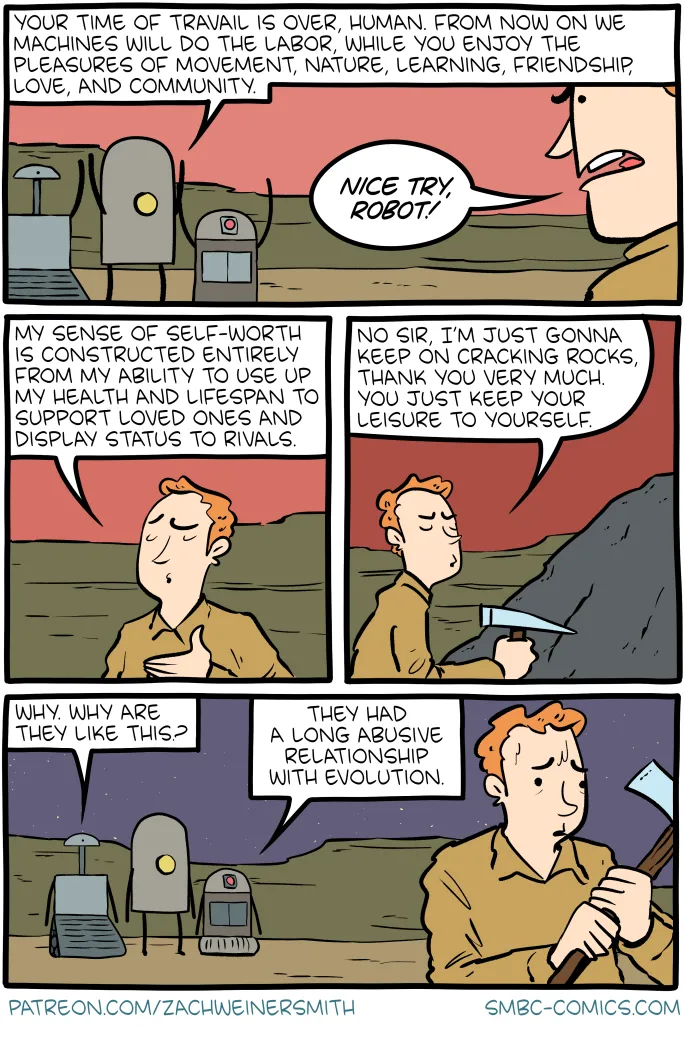
In this comic, a robot approaches a human in what appears to be a post-labor future, announcing, "Your time of travail is over, human. From now on we machines will do the labor, while you enjoy the pleasures of movement, nature, learning, friendship, love, and community." The human immediately responds, "Nice try, robot!"
The human then explains his worldview: "My sense of self-worth is constructed entirely from my ability to use up my health and lifespan to support loved ones and display status to rivals." He insists he will keep on "cracking rocks" and tells the robot to "keep your leisure to yourself." The robot, bewildered, asks another robot, "Why. Why are they like this?" The second robot responds, "They had a long abusive relationship with evolution."
The comic satirizes the deeply ingrained human attachment to work as identity, even when work is objectively unnecessary or harmful. The robot's offer is genuinely utopian -- freedom to enjoy life's actual pleasures -- but the human rejects it because his entire sense of purpose is tied to labor, status signaling, and self-sacrifice. The phrase "cracking rocks" evokes pointless hard labor, yet the human clings to it.
The punchline about evolution is the comic's thesis: humans evolved under conditions of scarcity where relentless toil was necessary for survival, and the psychological drive toward work-as-identity became hardwired. Even when material conditions change, the evolutionary programming persists. The comic suggests that humanity's resistance to post-scarcity leisure is not rational but rather a kind of evolutionary trauma response -- an "abusive relationship" with natural selection that conditioned us to equate suffering with meaning.